
Anita DeFrantz, Olympic Trailblazer
by Philip Barker and David Wallechinsky

Anita DeFrantz [Photo: IOC/Greg Martin]
“From my earliest days in the Olympic Movement, she showed me what courageous leadership looked like, and what was possible for women in sport. She broke barriers long before many of us had the opportunity to follow, and I will never forget that the path I have been privileged to walk was made possible by trailblazers like Anita,” Coventry insisted.
A statement from the United States Olympic and Paralympic Committee President Gene Sykes and Chief Executive Sarah Hirshland also remembered the contributions of DeFrantz to American sport and the wider Olympic movement.
“We have lost a giant of the Olympic Movement, and many of us have lost a dear friend. Anita DeFrantz was one of the most consequential Olympians our nation has ever known. To those of us fortunate enough to work alongside her, she was also a mentor, a truth-teller and a steady source of wisdom and grace.
“Her legacy lives on in every Team USA athlete who speaks and is heard, and in every girl who finds her place in sport.”
In 2019, DeFrantz’s contribution to the Olympic Movement was also recognised by the award of the ISOH lifetime achievement award. She was also included in the Court of Honor at the Los Angeles Coliseum, a tribute accorded very few.
In her own sporting career, DeFrantz won bronze when women’s rowing was included on the Olympic programme for the first time at the 1976 Montreal Olympics.
She read law at the University of Pennsylvania. Her legal career was destined to become intertwined with sport when American President Jimmy Carter ordered a boycott of the 1980 Moscow Olympics after the Soviet invasion of Afghanistan.
By this time, she was a pre-law advisor at Princeton whilst still retaining her own ambition to compete at the Moscow Games.
When the boycott was announced, she became a powerful advocate for the athletes and led a legal case against the United States Olympic Committee.
This “moved for an injunction barring defendant USOC from carrying out a resolution not to send an American team to participate in the Games of the XXII Olympiad to be held in Moscow in the summer of 1980. Plaintiffs allege that in preventing American athletes from competing in the Summer Olympics, defendant has exceeded its statutory powers and has abridged plaintiffs’ constitutional rights.”
Ultimately, the case was unsuccessful and no United States athletes competed in Moscow, but her action did bring her to the attention of the new IOC President Juan Antonio Samaranch.
“The year 1980 changed my life in many ways,” DeFrantz admitted. “Becoming an IOC Member never crossed my mind, but the path I took led me to that opportunity.”
She was involved with the 1984 Los Angeles Olympic Organising Committee (LAOOC) as a Vice President and later took charge of the LA84 foundation, a legacy project which organised and encouraged youth participation in sport. It also established a sporting library which continues to be used either in person or online by scholars and researchers around the world.
The Foundation inherited the library and collection of the Helms Athletic Foundation. Under DeFrantz’s leadership, the collection grew to 120,000 digital documents, and included 70 athlete oral histories. The library opened to the public in August 1988. In 1995, the library’s collection was made available to the public online free of charge. This included all Olympic Games Official Reports, as well as books, magazines, journals and other materials. The text of these items was fully searchable., This followed the same strategy as ISOH by ensuring as much information as possible is accessible to as many people as possible.
DeFrantz was co-opted as an IOC member in 1986 and elected to the Executive Board for the first time in 1992.
In 1996 in Atlanta, it was DeFrantz who encouraged athletes to vote in the first elections held for the Athletes Commission. Hitherto they had simply been appointed.
In 1997, she became the first woman to be elected an IOC Vice President and was also the first to run for IOC President but was unsuccessful.
She did serve again as IOC Vice President from 2017 to 2021.
Earlier this year, DeFrantz was invited to pass the Olympic Torch to Coventry when the Flame reached Milan.
“Anita opened doors for the rest of us, but her real legacy is that she expected us to keep those doors open for those who come next. We can only hope to live up to that,” Coventry added.
DeFrantz was the author of My Olympic Life: A Memoir, published in 2017
In her final years, DeFrantz had fought a courageous battle against cancer.
At Olympic House, the Olympic Flag will be flown at half-mast for three days in tribute to DeFrantz.
The first issue of the Journal of Olympic History in 2027 will include a full appreciation of Anita DeFrantz.
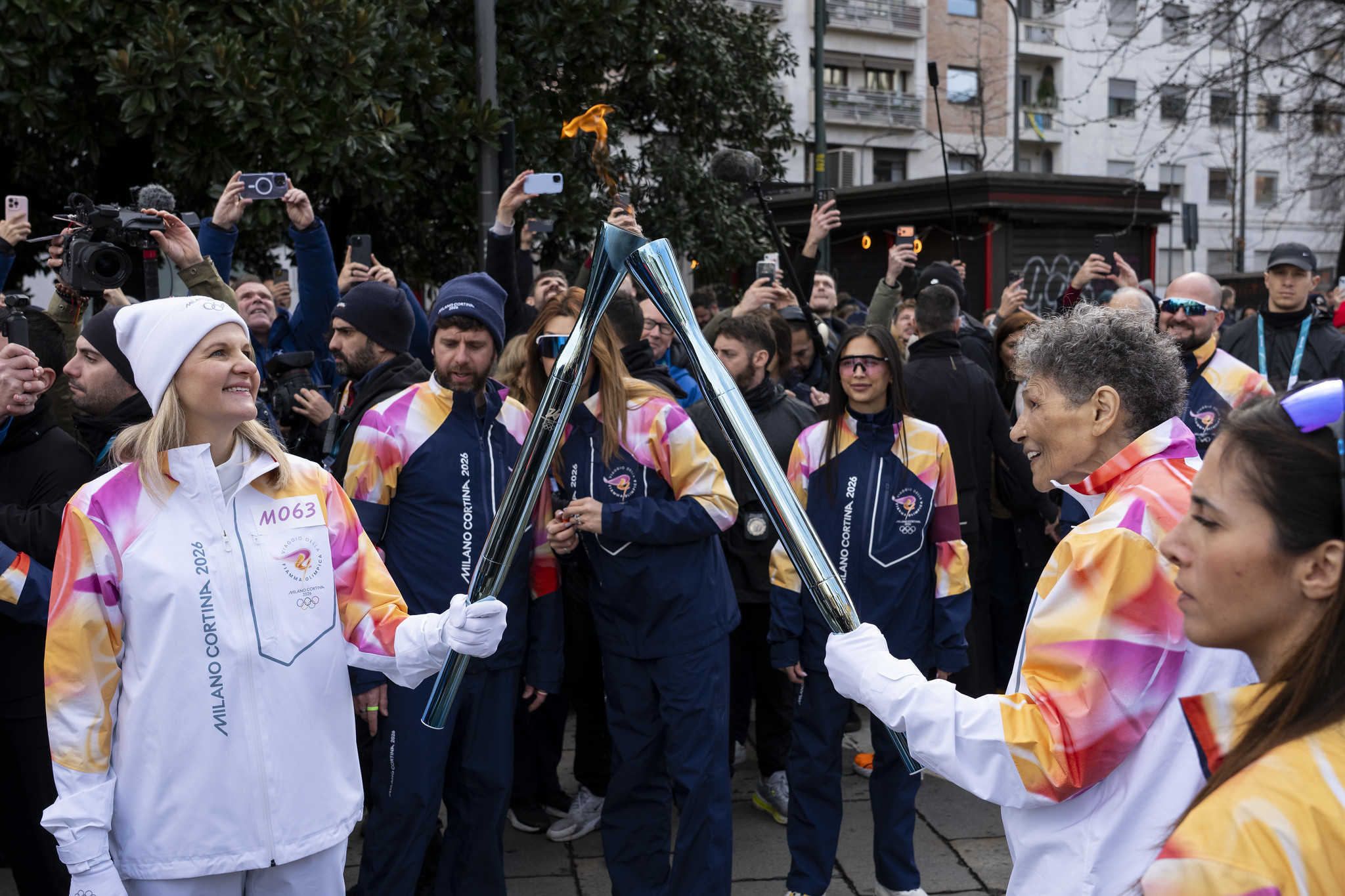
Anita de Frantz passed the Flame to Kirsty Coventry in Milan. [Photo: IOC/Quinton Meyer]
In addition to our website, you can also find information on Olympic history, personalities and stories on our social media platforms facebook, twitter and instagram @ISOHOlympic and Via Linked at LinkedIn: isoh.org/linkedin
There are no comments published yet.