
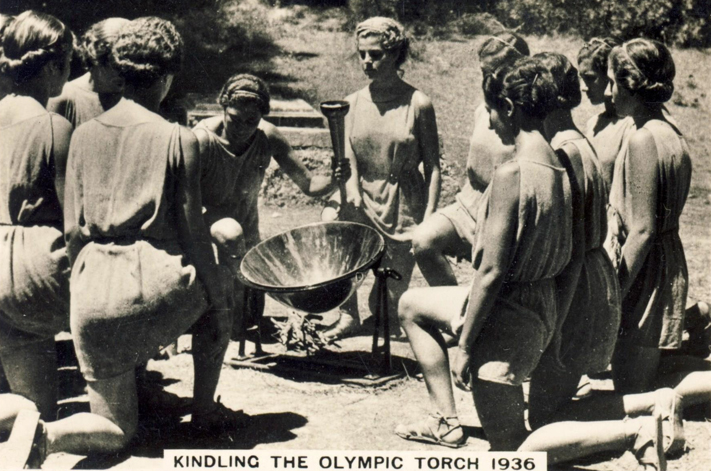
 1936 cigarette card depicts the first Torch Lighting.


A new High Priestess for Paris 2024 Flame
by Philip Barker
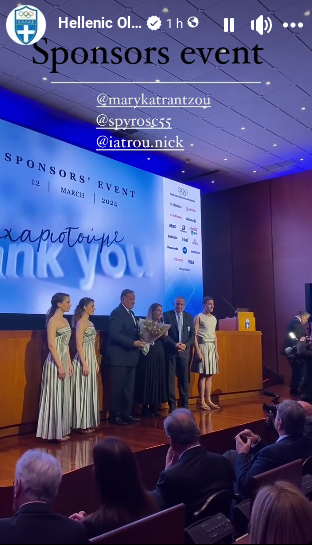
(Click image for announcement of the new High Priestess at Hellenic Olympic Committee ceremony)
The Olympic Flame for Paris 2024 is to be lit by actress Mary Mina.
The Ceremony is scheduled to take place on April 16th.
“This is a big honour for me. I hope to live up to the trust you placed in me.”
Mina had been chosen to succeed Xanthi Georgiou, a renowned Greek actress who had kindled the Flame for Tokyo four years ago when the ritual was held as the COVID-19 pandemic began.
As a result only specially invited guests were permitted into the ancient stadium for a Ceremony in which Rio 2016 pistol gold medallist Anna Korakaki became the first woman to begin the Relay.
In normal times local schoolchildren are encouraged to participate in the Ceremony and the anthems are often performed by a choir of youngsters.
The first to perform the role of priestess had been the dancer and teacher Aleka Katseli who lit a Flame destined for the 1936 Games.
The newsreels depict how the young priestesses surrounded the mirror used to ignite the Flame.
They were then shown in procession through the ruins before the first runner Konstantin Kondyllis began a relay which carried the Flame to Berlin entirely on foot.
The start of the actual Relay bore no resemblance to how it was depicted in Leni Riefenstahl’s film Olympia.
The runner shown in the film was Anatol Dobriansky, a photogenic youth who is understood to have carried the Flame in the early part of the actual Relay. He had been spotted by Riefenstahl and invited to participate in the sequences she filmed amongst the ruins in Delphi.
In 1948, there was civil strife in Greece. As a result it was not possible for the designated High Priestess to travel from Athens. Maria Aggelakopoulou, a local girl, was pressed into service.
The longest serving priestess was the late Maria Moscholiou, who lit the Flame for four successive Olympic Games from 1968 and for the Winter Games in 1976 and 1980.
“Creating the Olympic Light is an unbelievable feeling. Watching what happens next in the countries where the Olympic Flame is travelling is unbelievable.” she had said.
Greek Culture minister Lena Mendoni paid tribute to “The seriousness, elegance and prestige of the presence of Maria Moscholiou which were identified with the Olympic Ideal and with the lighting of the Olympic Flame.”
It was not until 1964 that the Flame for the Winter Games was also lit in Olympia.
The Ceremony was choreographed for the first time by Maria Horss, who had been one of the young participants in 1936. At the suggestion of Otto Symiczek, athletics coach and International Olympic Academy Dean, Horss resumed her connection with the Torch Relay, a role she was to play for over 40 years.
By 2008 when Maria Nafpliotu kindled the Flame, the direction of the Ceremonies had passed to Artemis Ignatiou.
A graduate of the National School of Music and dance in Greece, she had been a priestess herself from 1988 and had begun to assist Horss with the preparations.
Ignatiou is a noted performer and serves as a member of the Advisory Committee of the Ministry of Culture in matters of Dance and Secretary of the Greek Section of the International Dance Council of UNESCO.
Under her leadership the Flame Lighting Ceremony has developed to include dance sequences on the slopes of the ancient stadium and performances by the young men who represent the Heralds.
The television coverage has become more extensive and now deploys drone technology to provide dramatic images of proceedings.
More recently the trend has been for each priestess to carry out the lighting at an Olympic Games and a Winter Games.
Thus, Ino Menegaki lit the Flame for London 2012 and Sochi 2014 and Katerina Lehou took over for Rio 2016 and Pyeongchang 2018,
Georgiou ignited the first torch for both Tokyo 2020 and Beijing 2022,
Since 1992 this has been done with a specially created Torch designed by Greek jeweller Ilias Lalaounis.
It is only when Tokyo Olympic single sculls gold medallist Stefanos Ntouskos steps forward as the first runner that the signature Paris 2024 Torch will be lit.
He will wear a specially designed white Torchbearer uniform featuring the Paris 2024 emblem and edged with gold piping on the sleeve.
The costumes worn by the priestesses are expected to be two-toned black and white, a departure from the very pale blue dresses with olive green pleats in recent Ceremonies.
In some early Lighting Ceremonies, the priestesses had worn dark brown uniforms.
The High Priestesses 1936-2024
1936 Koula Pratsika
1948 Maria Aggelakopoulou
1952 Xanthippe Picheon – Theologoti
1956 Aleka Mazaraki – Katseli
1960 Aleka Mazaraki – Katseli
1964 Aleka Mazaraki – Katseli
1968 Maria Moscholiou
1972 Maria Moscholiou
1976 Maria Moscholiou
1980 Maria Moscholiou
1984 Katerina Didaskalou
1988 Katerina Didaskalou
1992 Maria Pampouki
1996 Maria Pamouki
2000 Thalia Prokopiou
2004 Thalia Prokopiou
2008 Maria Nafpliotou
2012 Ino Menegaki
2016 Katerina Lehou
2020 Xanthi Georgiou
There are no comments published yet.