
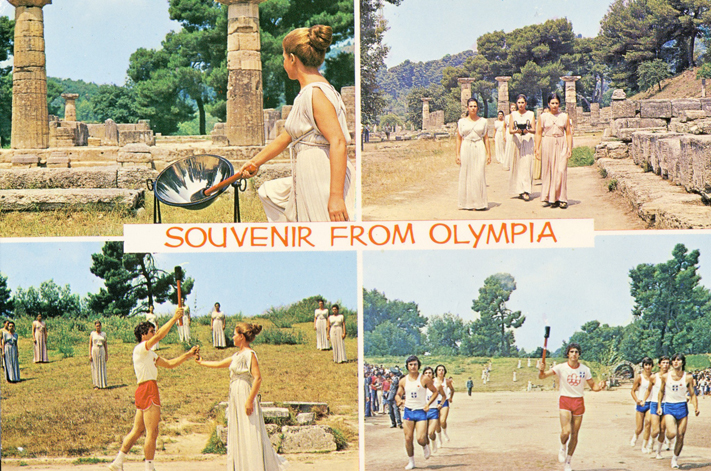
 The lighting of the Torch in 1976 depicted on a postcard.
A Flame Fit For a Queen
by Philip Barker
Celebrations have begun to mark 50 years since the Montreal Olympics began.
The Games of 1976 are often derided because of the problems which dogged their build up. Construction delays and spiralling costs put the Games in jeopardy and in the final weeks major political disputes threatened to wreck the Games.
When the athletes did arrive, they were subject to intense security, the like of which had not been witnessed before.
They also proved to be a Games of innovation with a lasting effect on the host nation.
“Looking back, it gives us a much more balanced historical perspective on what was ultimately a very successful Olympic Games,” said International Olympic Committee (IOC) Honorary President Thomas Bach who won fencing gold at the Montreal Games.
“Today, Montreal and Canada are recognised as preferred hosts for major international sporting events. All of that is part of the legacy of these Games, which helped put Canada on the map as one of the world’s leading hosts of international sport,” Bach added.
“I think it’s important to remember what we can do when we put our minds to it, because that was something that was quite extraordinary at the time and really built a foundation for future Games,” Canadian Olympic Committee President Tricia Smith said.
In 1976 she competed in rowing. It was the first time women’s rowing had been permitted at the Olympics.
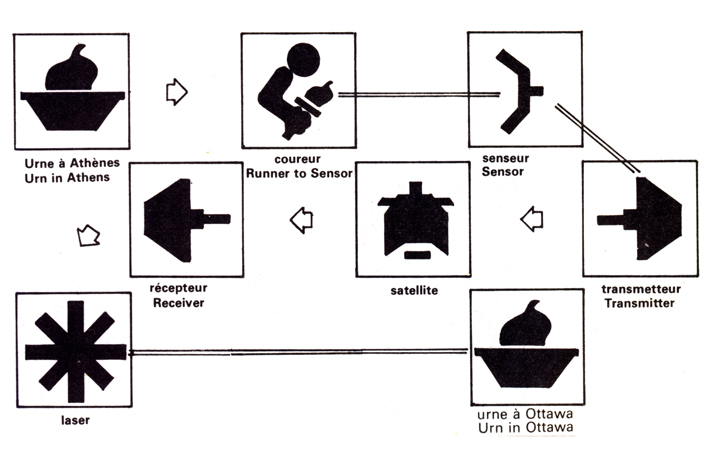
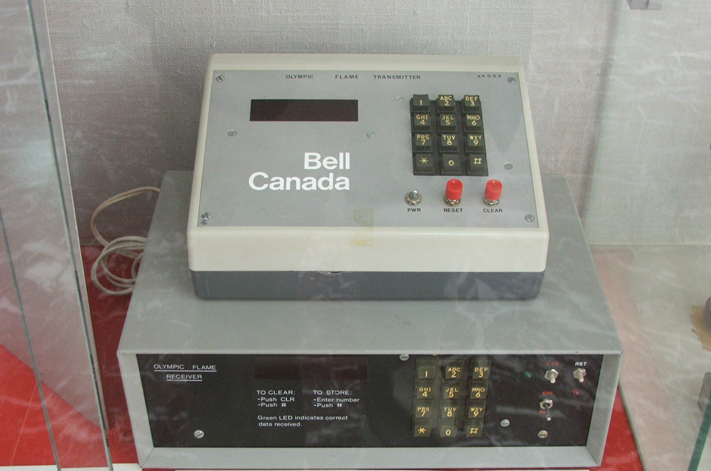
The innovation was to come at the Flame Handover in Athens. It was transmitted 7,786 kilometres from Athens to Ottawa in a split second by an electronic pulse.
“The route to be travelled by the Olympic Flame is based on a combination of tradition and modern technology,” the International Olympic Committee (IOC) Executive Board was told by the Montreal Olympic Organising Committee (COJO 76).
“The Flame ceremonies at Athens and Ottawa will take place simultaneously, with television linking the two capital cities and enabling people around the world to witness the transfer of the flame from Greece to Canada. The Ceremony in Ottawa is conceived as a salute to the ancient Flame.”
A group of businessmen from British Columbia led by former BC Lions Canadian Football team General Manager Herb Capuzzi raised C$300,000 towards the cost of the relay. In return they were given the right to choose 24 Torch bearers.
In Ancient Olympia, the Flame had been kindled from the rays of the sun by High Priestess Maria Moscholiou in Ancient Olympia. It was the third occasion that she had lit the Flame for the Summer Games.
The first bearer was high jumper Tassos Psilidis, accompanied by an escort of six local athletes as he headed to the Coubertin Grove.
“We thank our Greek friends, who protect the Olympic ideals with resolute faith and maintain inviolable the holiness of this Flame. May it unite the athletes and youth of the world in fraternity, loyalty, joy, and peace,” said Canadian Olympic Association Vice President Father Marcel de la Sablonierre who represented the Montreal Organising Committee (COJO) at the Ceremonies.
It fell to Angela Simota, a Canadian athlete of Greek heritage to transmit the Flame to Ottawa. Waiting for its arrival were Canadian Prime Minister Pierre Trudeau, IOC member Sir Arthur Porritt and Lady Killanin, wife of the IOC President.
17 year old Liz Street of Ottawa lit a torch and presented it to Trudeau on stage.
British Columbia Premier William Bennett was one of 12 runners who ran on the initial leg to represent the provinces of Canada. Each bearer wore a white tee shirt edged in red with the Montreal Olympic symbol and red shorts.
The Flame arrived in Montreal on the evening before the Opening Ceremony. It was carried by Kathy Kreiner, women’s giant slalom gold medallist at the Winter Olympics in Innsbruck. As it turned out, she was the only Canadian gold medallist in 1976. It was received by marathoner Gérard Côté, who had competed in the 1948 Olympics and won the Boston Marathon on four occasions.
Montreal Mayor Jean Drapeau watched the Flame arrive with IOC President Killanin, COJO Commissioner Roger Rousseau and Olympic minister Victor Goldbloom.
“This Flame we have lit tonight comes from a very long way away in both time and in the history of sports. We wanted to welcome the Flame in a very special place. I am elated we have chosen this place, our historic cross to honor the Flame at this fete,” Drapeau said.
On the final day, 15 year old Denis Pothier from Yamachiche, a municipality in Quebec and 16 year old Christine Gillespie from Ottowa lit torches from the cauldron to begin the final leg of the Relay at the stadium.
The Games were opened by the late Queen Elizabeth II in her capacity as Head of State of Canada. There had been considerable opposition from separatist groups in Quebec and some even made threats.
There were even dissenters within COJO’76 including Victor Goldbloom the Canadian politician who had been put in charge of the Olympic Installations Board (OIB) to ensure that all the major building work was completed in time.
“The Queen is a very nice person but it is not necessary to have persons from outside open our Olympics,” Goldbloom told a Francophone radio station.
Although many wanted Canada’s Governor General Jules Leger to open the Games, Trudeau invited the Queen after discussion with Quebec’s provincial Premier Robert Bourassa and Montreal Mayor Jean Drapeau.
In fact, The Queen received an ovation before making the declaration to open the Games in both French and English.
Shortly afterwards two Montreal born teenagers, athlete Stephane Prefontaine, representing the Francophone community, and 16 year old gymnast Sandra Henderson who lived in Toronto, on behalf of the English speakers, carried the Flame together to light the Olympic cauldron on a stage in the centre of the stadium.
The pair were chosen to “best represent the games to host province’s and would bring a message of hope to all the Young athletes of the world,” said COJO 76 Olympic Flame Director Paul Larue.
“It’s an honour that usually goes to a competitor at the last Games or someone like that. It was a great surprise to be chosen,” admitted Prefontaine.
“It’s probably the most exciting thing that has ever happened to me,” said Henderson.
For the opening ceremony, the cauldron was on a temporary light-weight aluminium stage in the centre of the field. It was subsequently moved to a position at the south end of the stadium away from the athletics track. It was the first time the location of the cauldron had been altered in this way, although in 1952 a cauldron had been lit in centre field before the Flame burned from a tower above the Helsinki stadium,
The next issue of the Journal of Olympic History, currently in preparation, will include special features and more detail on the 1976 Montreal Olympics.
In addition to our website, you can also find information on Olympic history, personalities and stories on our social media platforms facebook, twitter and instagram @ISOHOlympic and Via Linked at LinkedIn: isoh.org/linkedin
There are no comments published yet.