
by Dr. Christian Wacker
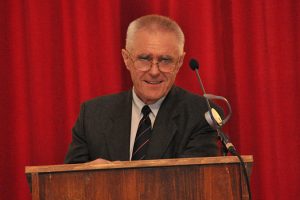 ISOH was very saddened this week to learn of the passing of Ingomar Weiler.
As you will be aware we formally announced our intention to present him with the ISOH Lifetime Achievement award during our General Assembly in Colorado Springs earlier in the month.
His family have told us that the tribute spoken by our President Dr Christian Wacker at the meeting was read to him.
It seems appropriate to reproduce those words here:
The International Society of Olympic Historians was delighted to honour the scholar of classics, Olympic researcher of ancient Olympia, connoisseur of the reception of antiquity, and interpreter of the modern Olympic Games, in short a universal scholar.
Ingomar Weiler was born in 1938.
After his studies he worked at the University of Innsbruck. After a longer research stay at the “Centre for Hellenic Studies” at Harvard University, his habilitation, a period of qualification to teach followed in 1972.
From 1976 to 2002, he held the chair of Ancient History at the University of Graz. Professor Weiler’s academic reputation was based on his research on Greek antiquity from an intercultural perspective. This resulted in six individual works, 138 articles in international journals and innumerable lectures in many countries of the world. Among his monographs, Greek History and the standard work Sport bei den Völkern der Alten Welt (Sport among the Peoples of the Ancient World) are particularly noteworthy. Among other things,he was the editor of the journal Nikephoros and the source books on the ancient sports disciplines. In 2007 he was awarded an honorary doctorate from the University of Mainz.
In his research, Professor Weiler combined sport with the thematic complex of ancient history. This focus included above all the problems surrounding the origins of sport, criticism of the Olympics, spectator behaviour as well as didactic tasks. He researched and disseminated ancient sports history like no other over the last 50 years, and above all, brought it closer to a broad audience in the sports world. He taught at the International Olympic Academy (IOA) for many decades and popularised ancient sports history by lecturing tirelessly and for hours at Olympia and other excavation sites on the nature of the “agon.” Unlike many other colleagues in his field, Professor Weiler always sought and found interdisciplinary contact outside of ancient studies with sports science.
I had the great fortune and honour to have met him at a young age. At that time, I had been working on my doctoral thesis in Ancient Olympia with Ulrich Sinn, who was an academic and also his friend. Professor Weiler was immediately interested in my work on the Gymnasium in Olympia, just as he was always interested in new research, new ways of thinking and in academic debates. This was a trait of his character, one who tirelessly strove to gain knowledge.
Together with big names in ancient Olympic historiography such as Henry Pleket, Stephen Miller, Nigel Crowther, Wolfgang Decker and Nikolaos Yalouris, I was invited by Ingomar Weiler as a doctoral student to a symposium in Graz in 1996 and thus introduced to the guild of Olympic researchers. On such occasions, one quickly realised that he was an important pioneer of the history of sport and the history of the Olympics in antiquity – with Henry Pleket at his side. His important publications Der Agon im Mythos (The Agon in Mythology) from 1974 and the still much-cited handbook Der Sport bei den Völkern der Alten Welt (Sport Among the People of the Ancient World) from 1988 bear witness to this. My contact with Professor Weiler was maintained and the academic exchange continued. I had the opportunity to publish several times in the journal Nikephoros, which he founded. It remains probably the most renowned journal on ancient Olympic history – and Ingomar Weiler gave me the great pleasure of collaborating again and again in congresses and publications that I organised.
Ingomar Weiler was undoubtedly a scholar, intellectual and researcher, but also an educator as a university professor, a motivator for teaching at his home university of Graz and especially for the International Olympic Academy. No professor taught so tirelessly and persistently at various courses of the Academy, but also at different national excursions.
“I am extremely grateful for the privilege of being able to teach in Olympia – it has been a great enrichment and a very valuable addition to my life,” is how he humbly described his passion for teaching.[1] Ingomar Weiler’s teaching and learning was well-known and irresistible, coupled with profound knowledge of sources with original Greek and Latin quotations, narrative passages, witty and humorous stories, and meticulous observation of archaeological details.
A tour of ancient Olympia with Ingomar Weiler could easily last 5-6 hours and felt like an unforgettable novel that you can’t put down. I had the privilege of teaching together with him at the IOA many times and we travelled together several times for sports teacher training with the German Olympic Committee. 100 teachers were selected, 50 in a bus with Ingomar Weiler and 50 with me. The week-long trip followed a well-known route from Athens via Nemea and Epidauros to Olympia and back via Delphi. A great contest of knowledge transfer and knowledge gain, which Ingomar Weiler was always able to win. Discussions continued into the evening and the enthusiasm for the Olympic Games in antiquity always spilled over. Ingomar Weiler was a scholar, but undoubtedly also a mediator, and he was not afraid to slip into the role of an ancient “hellanodic” in order to illustrate topics of antiquity. Scientific seriousness and academic rigour paired with tongue-in-cheek methodology of mediation, that is how his recipe for success might be described. He was constantly in search of knowledge and the Olympic idea: “Almost every postgraduate in Olympia gets to know the so-called ‘ancient immortal spirit,’ as Kostas Palamas (1859-1943) described it somewhat prophetically in his lyrics for the Olympic Anthem and how it was first sung about at the Games of 1896. The ‘autopsía,’ seeing with one’s own eyes, i.e., being at the place where the Olympic Games began, and the weeks of the postgraduates living together in the IOA, have all contributed to internalizing or at least understanding the main Olympic ideas.”[2]
Ingomar Weiler was also a fine mind, a fine person, musical and sporty at the same time. A small anecdote may underline this. On one of our teaching missions in Olympia, Professor Weiler and his wife Getrud invited my wife Marcia and I for coffee. The occasion was a very important one in terms of etiquette and protocol in the German-speaking world, which unfortunately is increasingly being forgotten. Following German convention, people address each other as Herr Weiler or Herr Professor until the older participant in the conversation offers the younger one the “Du”. Since that meeting, I was allowed to call Mr Weiler, Ingomar, which fills me with great pride to this day.
[1] Ingomar Weiler. “My experience and memories as a Supervising Professor during the years 1993 and 2017,” in 30 Years Olympic Studies for Postgraduate Students, ed. Georgiadis, Konstantinos (Athens: Printfair, 2022), 78.
[2] Ibid., 76.
There are no comments published yet.