
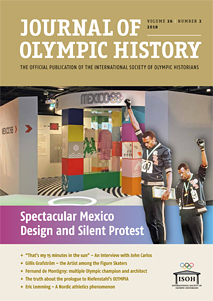
It was a stroke of luck that this year’s ISOH Meeting took place in Lausanne. Thus, the members of the Executive Committee had the opportunity to visit the exhibition OLYMPIC LANGUAGE, curated by General Secretary Markus Osterwalder in the Olympic Museum. It is well worth seeing, and it was a good idea to place the Mexico’68 design at its centre thereby remembering the Summer Games of 1968 which took place 50 years ago.
No one who thinks of those Games can forget the “Black Power” demonstration. Admittedly, it was a breach of the Olympic Charter. Yet with their silent protest the three medallists started a discussion on human rights in a way which had not been seen before. Ultimately it did more good than harm to the Olympic Movement.
In David Davis’ interview we learn how one of the three rebels, former US sprinter John Carlos views the events half a century later. It will give nothing away to reveal that he still regrets nothing. And when it’s a question of Mexico and “Black Power”, one is forced to talk about the former IOC President Avery Brundage, whom Anthony J. Wall describes as “Montecito’s King”.
Two articles are dedicated to famous Swedes. Ulf Lagerström has written up the biography of the phenomenal Eric Lemming. He was a multi-talented athlete who took part in four Olympic Games but stood out in the javelin which he was able to win in 1906 as well as 1908 and 1912.
The other is the figure skater Gillis Grafström, whose three Olympic victories and one Olympic silver medal is still unequalled today. Among the ice-skaters, he was the artist whose idiosyncratic style was rarely understood by his contemporaries. The anniversary of his 125th birthday was cause enough for a German Olympic champion, the walker Peter Frenkel, to organise an event in Potsdam,
where Grafström, who lived only to be 44, is buried.
The Sportimonium is the treasure chest of Belgian sports history, in whose creation ISOH Lifetime Award winner, Roland Renson, plays a large part. This time he leafs through the estate of Fernand de Montigny, who as an Olympic medallist in fencing and hockey was not only an all-round athlete, but also a successful architect responsible for the 1920 Olympic Stadium in Antwerp.
Eighty years after the première of the OLYMPIA film of Berlin 1936 and 15 years after her death, the legendary German director Leni Riefenstahl returned to the headlines. The present reason: the handing-over of her artistic estate to the Prussian Cultural Heritage Foundation. Yet not everywhere in the 700 chests of which the name Riefenstahl stands is her work inside. That is proved by the example of the OLYMPIA film’s prologue, whose true history has been researched by the editor of the Journal.
How collectors can enrich Olympic history is shown by ISOH member Christian Kunz. He discovered a series of postcards which show how, a hundred years ago, prisoners of war and internees organised “Olympic Games” behind barbed wire fences.
Enjoy your reading – and hopefully many new insights!
– Volker Kluge, Editor
Members of ISOH may view the digital version of this issue by clicking here.
There are no comments published yet.