
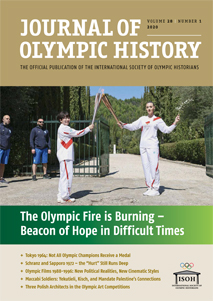
 With the lighting of the Olympic flame on 12th March, the countdown to the Games of the XXXII Olympiad in Tokyo has begun. Philip Barker reports from the ceremony in Ancient Olympia.
There have been doubts over the celebration of the Games before. In 1916, 1940 and 1944, neither Summer nor Winter Games were possible because of the World Wars. In other years, the build up to the Games has been overshadowed by political and economic crises, epidemics and pandemics. In 2016, the spread of Zika was considered a threat and now it is coronavirus. The IOC, Tokyo 2020 and the World Health Organization remain optimistic that they will able to overcome this challenge.
In part four of his series on the history of the Olympic films, David Wallechinsky examines 1988 to 1996, when it was believed that the Cold War was over. Today we know that the world has not become more peaceful since then.
One of many unresolved problems has been the relationships between Israel and Palestine. San Charles Haddad’s book The File: Origins of the Munich Massacre deals with it. In this issue, he has written the first of a series of articles on the them and it is hoped that these will promote dialog within the Olympic family.
Roy Tomizawa looks at Japan’s Olympic traditions. In 1964, when Tokyo hosted the Games for the first time, the gymnasts retained the team gold medal won by Japan in Rome. But only a single gold medal was awarded to the entire team because the IOC had classified the competition as “artificial”. The team members only received diplomas. Tomizawa’s hope that the IOC might strike a medal for each individual member was disappointed. He had to accept that the regulations in force at the time were part of history too.
Austrian skiing legend Karl Schranz, enjoyed a career of over 17 years but chased Olympic gold. He too has had to come to terms with it. When the 2020 Olympic marathon and race walking competitions were moved from Tokyo to Sapporo, it brought back memories of the 1972 Winter Games, including the “Schranz case” in particular. This was because he was the only athlete to be excluded from the IOC due to a violation of Rule 26. In this edition you can read how Schranz feels 48 years later.
Nobody is concerned about the rule on amateurism. It was relaxed somewhat in 1981 and then completely abolished. At present the focus is on Rule 50 of the Olympic Charter, which prohibits the participants from demonstrations or political, religious or racial propaganda at the Olympic sites. IOC Doyen Richard W. Pound argues that by retaining it, there is no restriction of the fundamental right to freedom of expression. His article describes it as an element of mutual respect and the conviction that a better world, with a balance of rights and associated responsibilities, is possible.
Natalia Camps Y Wilant and Kamil Potrzuski provide a retrospective look at three architects of Polish modernism. Kevin McCarthy makes a plea for the 1904 All-round Olympic champion Tom Kiely to be listed as ‘Irish’ in Olympic statistics.
– Volker Kluge, Editor
Members of ISOH may view digital versions of all issues by clicking here.
There are no comments published yet.