
 A night at the Opera was the first performance.



Truly magical Games end in Verona
by Philip Barker at the Arena di Verona
The Olympic Flame was extinguished simultaneously at Milan’s Arco della Pace and the Piazza Angelo Dibona in Cortina D’Ampezzo to bring the Milano Cortina Olympic Games to an end.
International Olympic Committee (IOC) President Kirsty Coventry made the closing declaration in time honoured words.
“In accordance with tradition, I call upon the youth of the world to assemble four years from now in the French Alps, to celebrate with all of us the 26th Olympic Winter Games,” Coventry said.
“Italy, thank you for making these Games truly magical,” she added in Italian.
Legendary Italian short track skater Arianna Fontana brought a lantern onto the stage for the finale.
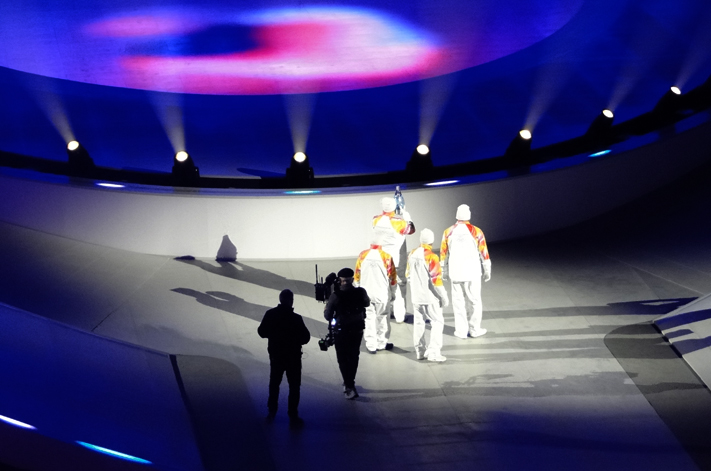
Although there was not a cauldron inside the arena, “A Drop of Fire” was added to the Ceremony. Italy’s 1994 gold medal winning cross-country relay quartet — Maurilio De Zolt, Marco Albarello, Giorgio Vanzetta, and Silvio Fauner — brought the Flame into the arena.
“We promised to provide athletes and the Olympic Movement with a unique experience in world class venues, framed by landscapes of striking beauty, respectful of sustainability, with an enduring legacy, well done Italy, you kept your promises.” Milano Cortina 2026 President Giovanni Malagò had told the crowd.
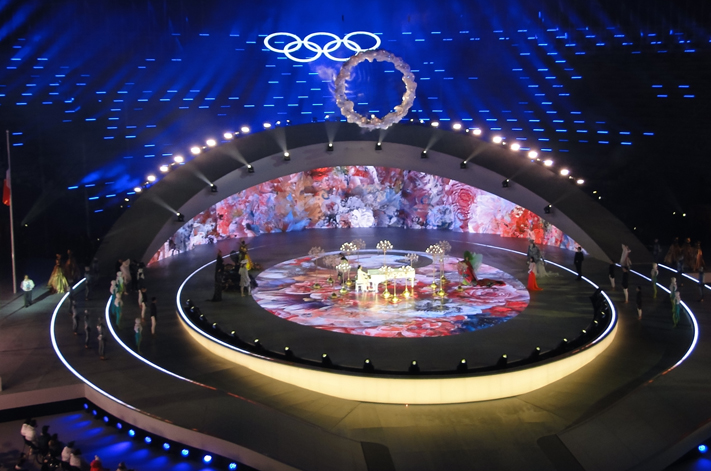
The Ceremony promised “Beauty in Action” on a stage set against an ancient backdrop. “The stage design was inspired by the identity of the Arena di Verona, a historic and symbolic structure imbued with meaning,” Ceremony producers explained.
It began with “A Night at the Opera” which again drew on the wonderful tradition of Italian music as the Opening Ceremony had done.
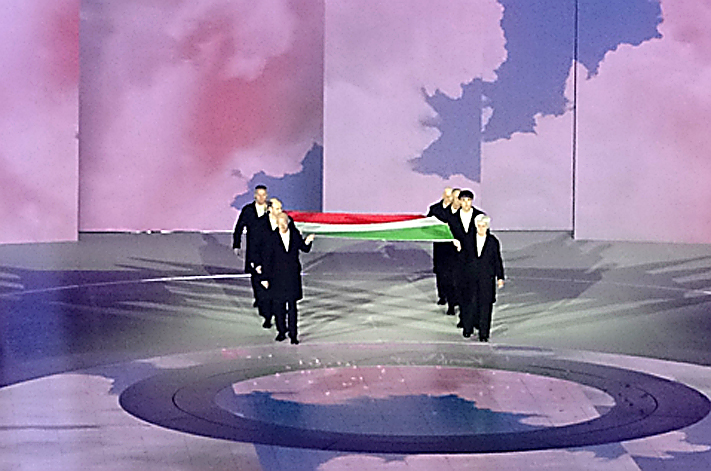
The Italian Flag was trooped in by Luca Gandini, a volunteer with the White Cross of Cortina. Biathlon official Rudolf Wieser represented Antholz and Anterselma, Sergio Longo a volunteer participated from Tesero, Marinella Canclini a four-time Olympian in short track on behalf of Bormio, Azienda Promozione Turistica Livigno President Luca Moretti and Fabio Morandini, an athlete, coach and official in Predazzo. This was a tribute to the communities which had staged the Games.
Later there were performances of aerial ballet and even the appearance of two gondolas in a sequence entitled “Water Cycle.”
Outside the arena as the teams arrived, they had been greeted by characters from Italian opera. The Olympians walked across a red carpet decorated with representations of the statues of the pharaohs from Verdi’s Aida.
It was in 1956, the year of Cortina’s first Winter Games, that John Ian Wing, a Chinese Australian boy had proposed that teams should march in without distinction of nationality at the Closing Ceremony in Melbourne. The entry has since been more informal.
The tribute to the volunteers really did take centre stage. They formed the Milano Cortina emblem and were joined at the end by 88-year-old Mario Gargulio who had been a young volunteer at the 1956 Games in Cortina D’Ampezzo.
The newest members of the IOC Athletes Commission, bobsledder Won Yun-Jong from South Korea and biathlete Johanna Talihärm from Estonia came onto the stage to present flowers to the volunteers.
A wonderful sequence called “Elevation” expressed the efforts of the athletes to reach the top and dancers from the Teatro di Roma performed an aerial ballet.
The Olympic Anthem was performed superbly and sung in Greek as the Olympic flag was lowered by the Italian Army’s Guard of Honour. The Choir and Orchestra of the Fondazione Arena di Verona were conducted by Francesco Ommassini.
The spectators had been encouraged to use the lights on their mobile devices to create a special effect during the anthem. In 1960 when Rome staged the Olympics, the crowd needed no instruction. They spontaneously set light to their programmes.
As for the Opening Ceremony, a small printed programme was produced here although none were set alight. They will surely become collector’s items and the decision to produce them was very welcome.
There was a new and impressive version of “La Marseillaise” arranged by Thomas Roussel as the French Alps received the official “Oslo” Handover Flag. Their presentation included 25 musicians and 24 athletes who formed a ring centre stage during a cinematic sequence which embraced the regions which will host in 2030.
The Flag was received by Auvergne-Rhône-Alpes regional council President Fabrice Pannekoucke and his Provence-Alpes-Côte d’Azur counterpart Renaud Muselier.
The Flag has been taken to Albertville for a homecoming celebration by the French. In another coincidence it was Cortina d’Ampezzo which first received that very flag 70 years ago after their successful Games.
The next edition of the Journal of Olympic History will include a special section on Milano Cortina 2026 with articles and information on all aspects of the Games.
In addition to our website, you can also find information on Olympic history, personalities and stories on our social media platforms facebook, twitter and instagram @ISOHOlympic and Via Linked at LinkedIn: isoh.org/linkedin
There are no comments published yet.