
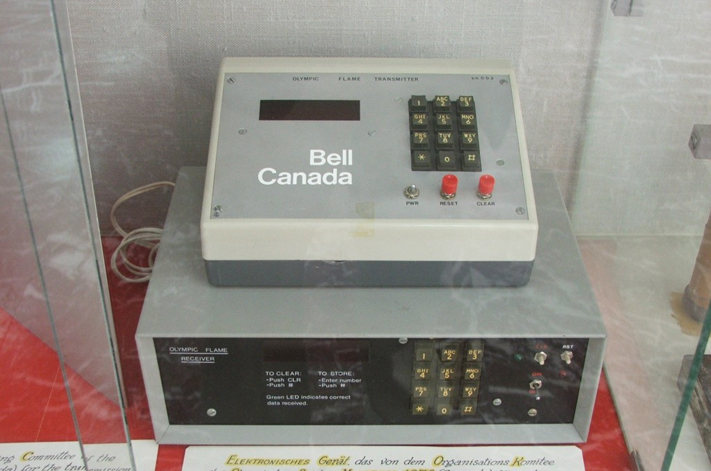
 The electronic machine used at the Handover Ceremony in 1976.


Pass the Flame, Unite the World
by Philip Barker at the Panathinaiko Stadium in Athens
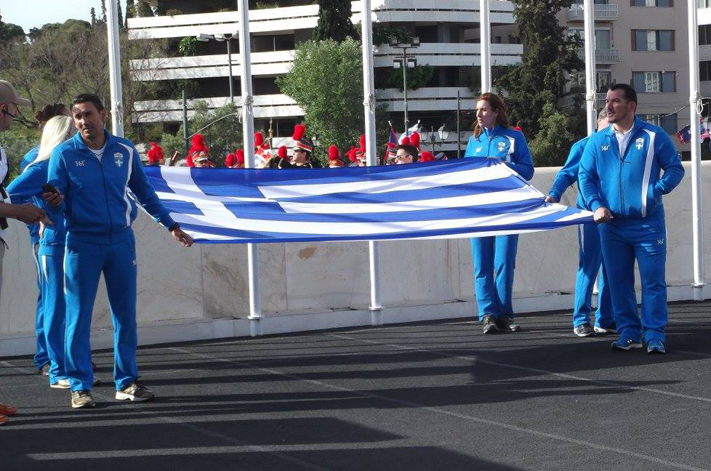
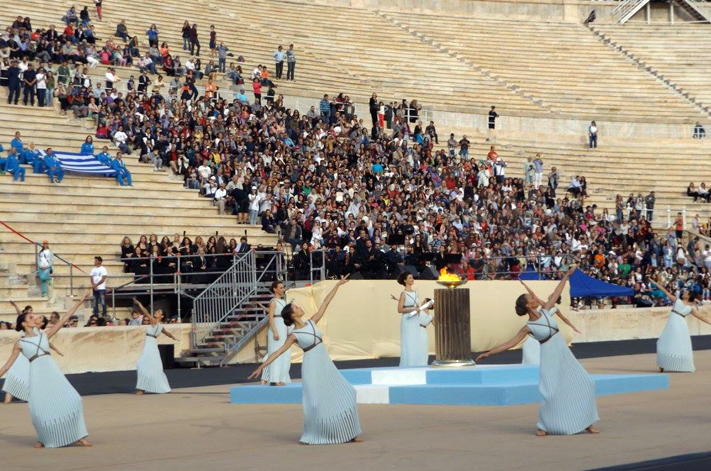
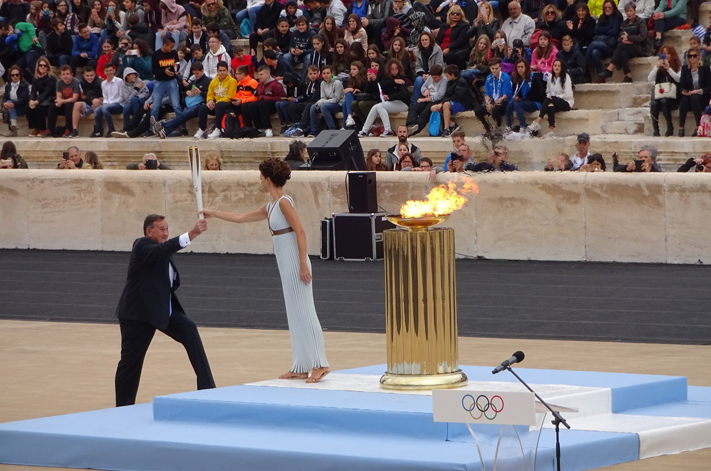
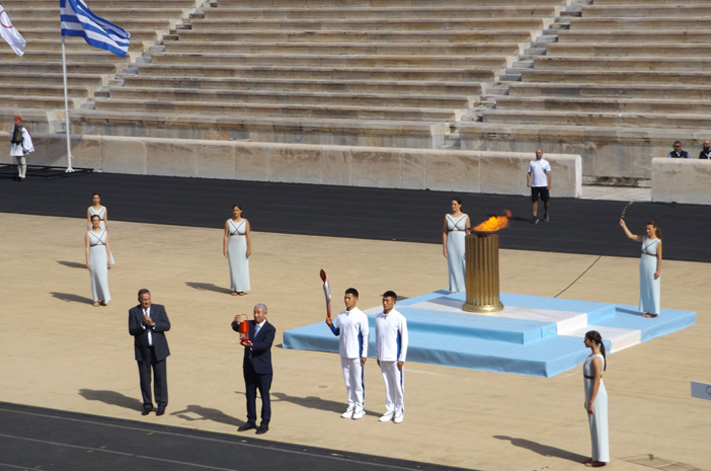
The Olympic Flame is to be formally handed over to Paris at an evening Ceremony in Athens after its ten-day journey across Greece.
The appearance of Nana Mouskouri to sing “La Marseillaise” and the Greek National Anthem is keenly awaited even though Mouskouri is to celebrate her own 90th birthday later this year.
The passage of the Flame through the Panathinaiko Stadium which had been the main setting for the first Olympics of the Modern era has become an important event.
Four years ago, precautions against the looming COVID-19 crisis dictated that only a small party of dignitaries from Tokyo 2020 were present for the Ceremony.
Rio 2016 pole vault champion Katerina Stefanidi lit the cauldron in the stadium but instead of a usual dance performance, only High Priestess Xanthi Georgiou and Ceremony Choreographer Artemis Ignatiou appeared in a short procession.
Tokyo 2020 made an eleventh-hour decision not to send triple judo gold medallist Tadahiro Nomura and three-time wrestling champion Saori Yoshida to collect the Flame.
Instead, it was received by Naoko Imoto, a swimmer at the 1996 Olympics who worked in Athens as Head of Education for the United Nations’ children’s agency, UNICEF.
She wore a jacket in cherry red, the national colour of Japan as she took the Flame from Hellenic Olympic Committee (HOC) President Spyros Capralos.
“We deeply regret that our Japanese friends have been unable to join us but under no circumstances has the flame lost its brightness,” said Capralos.
“We hand over the flame in the spirit of friendship.”
Four years ago, the Flame was flown from Athens to Japan but this time it is set to travel across to the nearby Port of Piraeus for a second moment of farewell.
This echoes the events of 1960 when the Flame was carried on the naval training ship Amerigo Vespucci to Syracuse in Sicily.
In 1976, no special transport for the Flame was needed.
As Greek President Constantin Tsatsos watched, there was a floodlit parade in which groups of young people represented the Olympic cities which had previously held the Olympics.
Then decathlete Kostas Kostis arrived with the Flame at the altar placed in the centre of the stadium.
HOC President Apostolos Nikolaides presented the Flame to Father Marcel de la Sablonnière, the representative of the Montreal 1976 Organising Committee.
Then, Angela Simota, a Canadian athlete of Greek heritage moved the flaming torch to a sensor which transmitted it directly by an electronic pulse to Canada.
“If the ancient Greeks had been able to see this instantaneous transmission of the flame, they would have considered it an act of the gods,” observed Canadian Prime Minister Pierre Trudeau.
The Handover Ceremony for 1992 proved emotional. Barcelona Mayor Pasqual Maragall recited the opening verses of an anthem for the 1936 “People’s Olympiad” in Barcelona, cut short by the outbreak of the Spanish Civil War.
“Not for hate, not for war do we come to struggle in every land. Beneath the blue sky our only cry is one of joy: peace. Away with envy, away with shackles, against a narrow life we claim our right to make a cleaner air to make a world abloom with roses.”
In 1996, although the Olympics were to be held in Atlanta, the 100th anniversary of the first Games in Athens called for a special event in celebration. The city had also arranged a gala evening at the stadium itself, featuring a re-enactment of the athletic competitions from 1896.
“It is our way of saying happy 100th birthday to the Olympic Games tradition that was revived here in the Greek capital.”
“Exciting moments from Olympic history will be revived in the same place which hosted the first Olympic Games,” organisers promised.
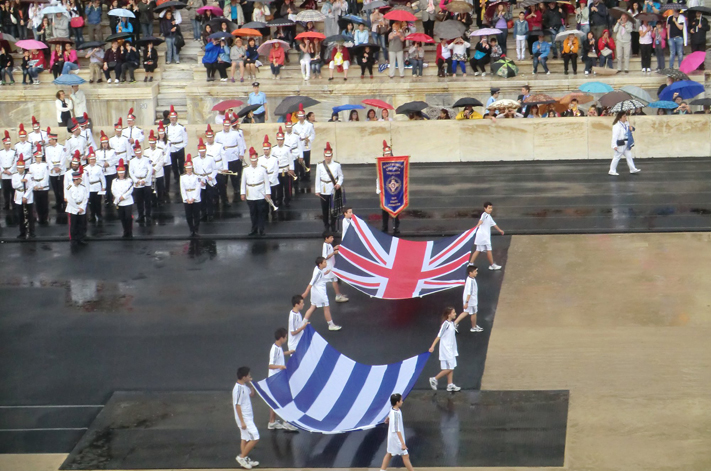
It proved a chilly afternoon in Athens with rain in the air, but even so, the ancient marble stadium came alive with athletic performances as it had done a century before. All the competitors were men, and drawn from the countries which had originally taken part in the 1896 Games.
“We have adopted the rules and regulations under which the first Olympics took place,” said organisers.
The first gold medal in the 1896 Games had been won by James Connolly of the United States of America in the triple jump. This time victory went to Jean-Pierre Sarant of France. His leap of 15.96 was over two metres longer than Connolly’s winning effort a century before.
When night fell, the haunting music of composer Petros Tabouris filled the air, spotlights picked out windsurfer Nikos Kaklamanakis and high jumper Niki Bakoyianni as they carried the Flame into the stadium.
Despite the cold, the atmosphere was electrified by a magnificent performance of the Olympic hymn by orchestra and male voice choir.
Written by Spiros Samaras with lyrics by Kostis Palamis, it had been performed for the first time 100 years before at the Olympic Opening Ceremony in 1896.
Then a symbolic Torch Relay with a specially manufactured Torch took place. A single runner represented each of the cities which had staged the Games.
The first runner was 1992 hurdles champion Voula Patalidou of Greece and she was followed by a cavalcade of illustrious names which included 1976 steeplechase gold medallist Anders Garderud to represent Stockholm; Shirley Delahunty, star of the 1956 Melbourne Games in Australia; Italy’s 1960 200m champion Livio Berutti for Rome; 1988 swimming gold medallist Adrian Moorhouse and modern pentathlete Dominic Mahoney on behalf of London.
IOC member Anita de Frantz and Roger Kingdom both carried the Flame to represent the American cities of St Louis from 1904 and Los Angeles in 1932 and 1984.
Long Jumper Heidi Rosendahl and sprinter Renate Stecher both won gold at the 1972 Munich Games, but also represented Berlin 1936, the year the Torch Relay was introduced.
As each participant completed their leg, they were taken in an open top horse drawn carriage through the city before arriving back at the Hotel Grande Bretagne.
It wasn’t so much cold weather as the rain which proved the problem in 2012 when the Flame was formally handed over to the Princess Royal in her capacity as President of the British Olympic Association.
There was great excitement as David Beckham joined the delegation but he could scarcely be seen under an umbrella as the downpour increased.
Legendary Chinese gymnast Li Ning who had so memorably ignited the cauldron high above Beijing’s Bird’s Nest Stadium in 2008 joined legendary Greek weightlifter Pyrros Dimas to light the cauldron.
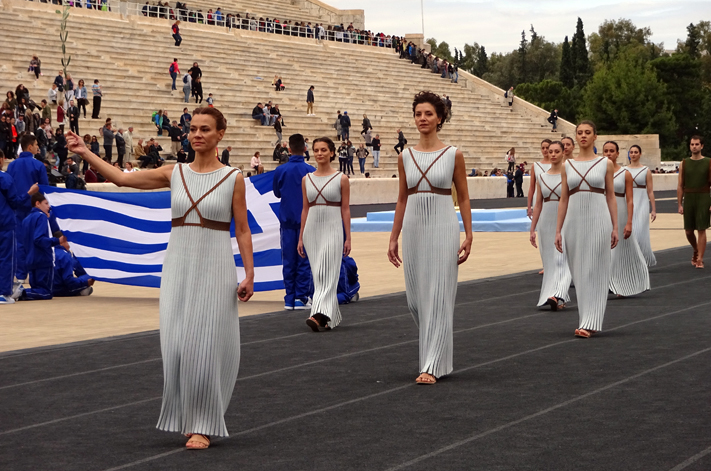
The priestesses performed a routine which contained a musical surprise, as the melody included a short phrase from “Imagine” by John Lennon in tribute to Great Britain.
“It was as a surprise for London,” explained choreographer Artemis Ignatiou. “It was an idea that I had with the composer. We used it only in the Handover Ceremony since I believe the lighting ceremony should remain archaic.”
Four years later, the inclusion of “Cidade Maravilhosa” the city anthem of Rio de Janeiro and originally composed for the Rio Carnival, delighted Brazilians watching “their” handover Ceremony.
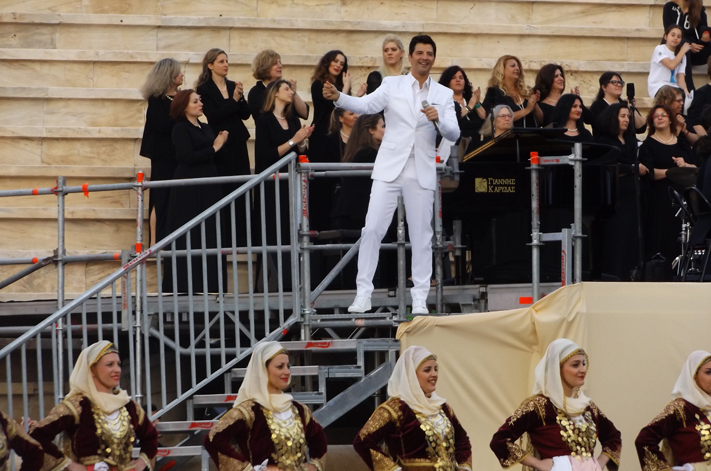
Greek television personality Sakis Rouvas also made an appearance dressed all in white.
Only twice has the Flame not passed through Athens. In 1948 a civil war prevented its journey.
In 1984, the Flame was flown direct to New York after a dispute between the Greek authorities and the Los Angeles Olympic Organising Committee over the latter’s decision to allow some to participate in the Relay in return for a contribution to the Youth Legacy Kilometer (YLK) fund, designed to aid sport amongst young people.
When Athens staged the Olympics in 2004, the Ceremony in Athens did not so much relinquish the Flame but pass it to the world for an international Relay, the like of which had not been seen before. It even had its own musical accompaniment, “Pass the Flame Unite the World.”
The first Olympic Relay had visited Athens in 1936 before heading north overland to reach Berlin. Andreas Paouris, a distance runner from the 1928 Games in Amsterdam, carried the flame down from the Acropolis Hill.
As he did so, the actor Nikolaos Rozan spoke: “Torchbearer, announce to the world that the Olympic spirit has not died.”
Another long-distance runner, Alexandros Kranis, entered the stadium with the Flame. As he did so there was a huge roar from a crowd which included the King of Greece. The ceremonial Evzones displayed the flags of all the competing nations in Berlin and there was also a display of ancient Games and dances. After the festivities, the flame headed towards the Bulgarian border and continued overland to Berlin.
The Olympic fire did not return to Athens until 1952. When the runners left the Stadium they headed for the airport, as the flame travelled by air for the first time on the way to Helsinki.
Now the Flame will revert to a more sedate journey, first taken in 1960 by the sailing ship Amerigo Vespucci for the Rome Olympics.
The three masted Belem will convey the Olympic fire from Piraeus to Marseille.
There are no comments published yet.