
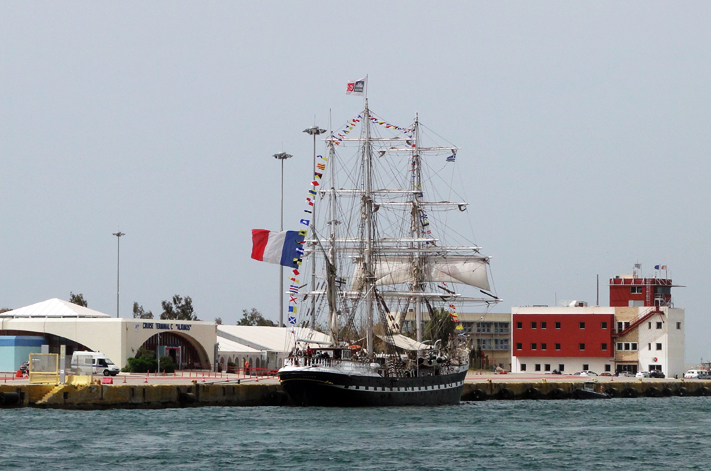
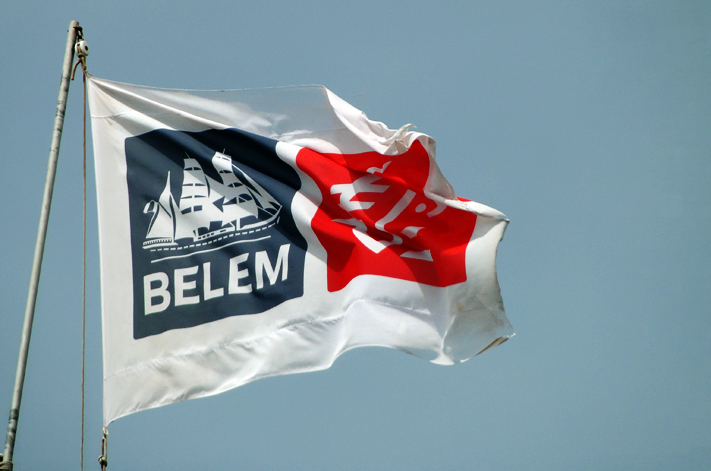
 The tricolor billows on the Belem awaiting the Flame in Pireaus.
A Flame on the Ocean Wave
by Philip Barker in Piraeus
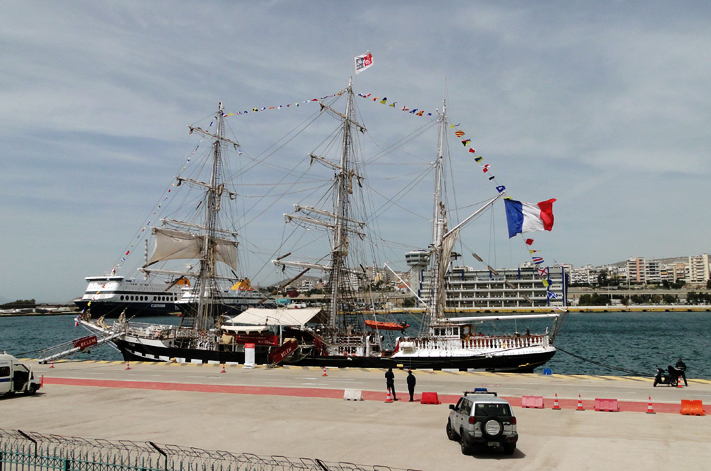
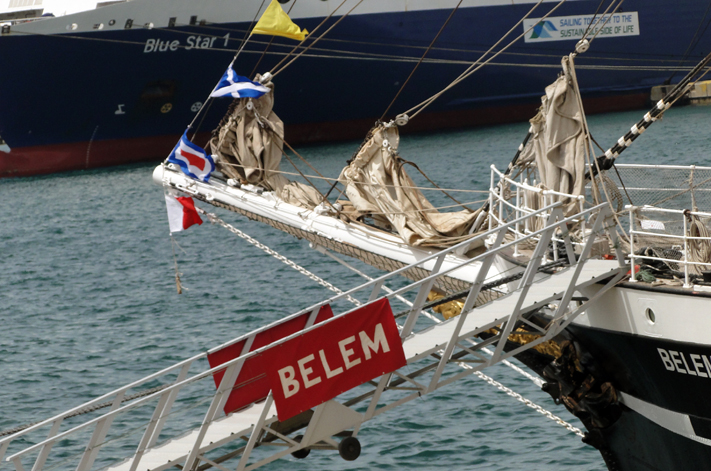
The historic three masted sailing ship Belem is ready and waiting at the port of Piraeus to convey the Olympic Flame from here for Marseille on a voyage Paris 2024 organisers have predicted will be reminiscent of a “true Homeric epic.”
The ship was first commissioned into service in 1896, the year Athens hosted the first Olympics of the Modern Era and already has Olympic heritage.
In 2012, it was moored on the River Thames as the London Flame passed in The Queen’s Royal Row Barge Gloriana on the day of the Opening Ceremony.
The Belem is now owned by Caisse d’Epargne Belem Foundation, sponsors of Paris 2024.
The voyage is designed to carry a strong environmental message, quite a contrast from the last Flame to arrive for an Olympic Games on French soil.
The supersonic aircraft Concorde was used to bring it to Paris for the 1992 Albertville Winter Olympics.
This time, the journey will be made across the high seas and is scheduled to arrive in Marseille on May 8.
From there it will be taken on a journey of some 69 days.
Although some officials have claimed to the contrary, this is not the first time that such a journey has been undertaken.
In fact this latest journey under sail may well evoke memories of the 1960 Rome Olympics when Olympic organisers reached an agreement with the Italian Navy.
The 1960 Olympic Flame is carried aboard the Amerigo Vespucci.
The training ship Amerigo Vespucci was made available for a sea voyage to transport the Flame from Piraeus to Syracuse on Sicily.
Timing was all important because organisers did not wish for the Flame to arrive on Italian soil any earlier than August 18th.
There was a further consideration. Prince Constantine was to participate in the official event at Piraeus in his capacity as Hellenic Olympic Committee (HOC) President but he was also scheduled to depart for the Aegean island of Tinos on the 14th August.
Later Constantine travelled to Italy himself to compete in the Olympic sailing at the Bay of Naples (successfully as it turned out, because he won gold in the Dragon class).
Prince Constantine carries the 1960 Olympic Torch.
“The Committee established that the sea voyage from Phaleros to Syracuse should not exceed five days,” recorded the Official Report of the 1960 Games.
“It was therefore absolutely necessary to accept these limiting factors and to arrange for the Vespucci to effect a slow voyage circumnavigating the Peloponnese.”
So, on the evening of August 13th, the Prince, wearing full naval uniform, received the Flame at Piraeus.
Italian Olympic Committee Vice President Piero Oneglio, representing the Organising Committee took the Flame and in turn passed it to Olympic Torch Committee Vice-President Aldo Mairano.
It was then taken to the Amerigo Vespucci where an Italian navy cadet ignited a cauldron on the bridge.
The ship arrived at Syracuse in Sicily on the evening of August 18th. By the time it appeared before the eyes of the world at the Opening Ceremony in Rome, it had covered some 1,532 kilometres.
In 1968, the Flame also travelled by sea. On this occasion it crossed the Atlantic on the corvette Princesa before the Mexico Olympics. Swimmers brought the Flame ashore. Much of the journey was accompanied by ISOH member Conrado Durantez who later wrote two extensive histories of the Torch Relay.
The Atlantic crossing is to be repeated this summer.
In June, the journey around the French mainland is to be broken for the first stage of an “Oceans Relay” in which the Flame is scheduled to cross the Atlantic, the Indian Ocean and the Pacific to the overseas territories of Guadeloupe, Guyana, Martinique, French Polynesia, New Caledonia and Reunion Island. The Flame will be carried on board a trimaran named Le Maxi Banque Populaire XI skippered by round the world yachtsman Armel Le Cléac’h.
So much time is to be spent on the water that designer Mathieu Lehanneur incorporated a motif reflecting water in his design for the Olympic Torch.
By coincidence the first sea voyage for the Flame was also the first time the Flame visited French soil.
In 1948 it was conveyed to Corfu by the Royal Hellenic Navy. From there the British Mediterranean fleet took over as HMS Whitesand Bay continued to Bari.
After an overland journey through Italy, Switzerland France, Luxembourg and Belgium, it returned to French soil for a final journey to Calais.
From there another sea voyage, this time on HMS Bicester, took the Flame across to Dover less than 24 hours before the Olympic Games were to begin.
There are no comments published yet.