
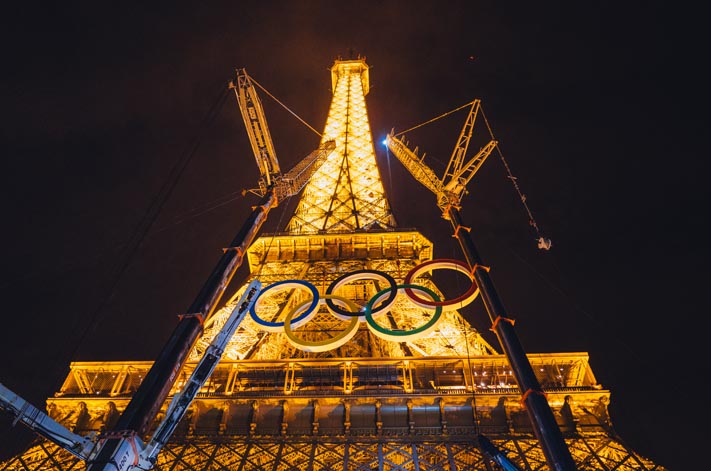
 Crews work to install the Olympic rings overnight on the Eiffel Tower. [Photo: Paris 2024/Boby]

A Sight to Remember in Paris
by Philip Barker
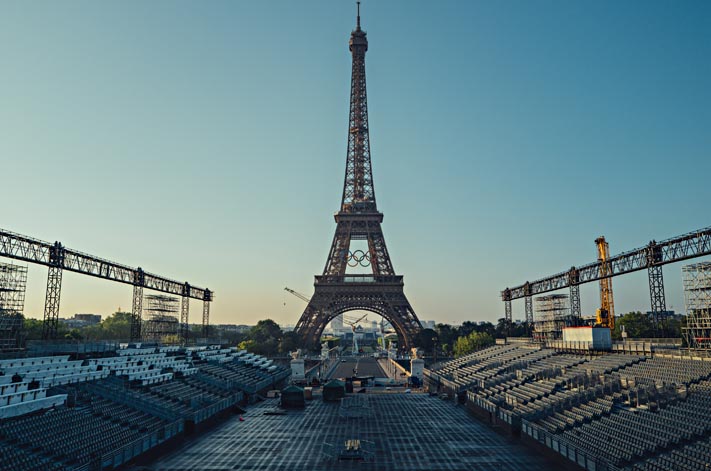
Giant Olympic Rings have been installed at the Eiffel Tower in celebration of Paris 2024.
“We wanted a sight to remember,” said Paris 2024 President Tony Estanguet.
The Eiffel Tower is Paris, it’s the face of France.”
The installation was carried out overnight by a team from Games sponsor ArcelorMittal, the Société d’Exploitation de la Tour Eiffel and Paris 2024.
Four cranes were needed for the operation to assemble the Rings which are 29 metres wide and 13 metres high.
“In the world of the Games, we call these giant Rings ‘Spectaculars,’ and I can’t think of anything more spectacular than the Eiffel Tower,” Estanguet insisted.
Many were surprised when Paris 2024 decided not to use the Eiffel Tower in the Games logo.
A fragment of salvaged metal from the structure has however been included in every medal to be awarded at the Olympic and Paralympic Games.
Host cities in recent years have made great efforts to find appropriate places to display Olympic Rings.
40 years ago they were positioned on the tower at the Los Angeles Coliseum.
Rafer Johnson lit a taper which sent the Flames soaring through the Olympic Rings to ignite the cauldron at the Opening Ceremony.
In 2000 the rings were famously positioned on the Sydney Harbour Bridge.
The idea had come from Ric Birch, supremo of Sydney’s Olympic Ceremonies.
Sydney Olympic Organising Committee President Michael Knight had dismissed it as “an extravagance.”
International Olympic Committee marketing chief Michael Payne revealed in his book that “Either the International Olympic Committee was going to have to ‘volunteer to pay,’ or Knight would have to be ‘tricked’ into agreeing.”
Payne therefore passed a note to IOC President Juan Antonio Samaranch and asked him to read it at the end of a meeting.
“‘Mr. Knight, I understand that you are considering applying the Olympic Rings to Sydney Harbour Bridge for the Games,’ said Samaranch, squinting at my handwriting,’ but are not sure if you need the IOC’s approval. I think it is an excellent idea and I am pleased to approve it.”
In 2012 there were giant Rings at St. Pancras railway station in London, the main terminal for the Eurostar service welcoming visitors to London.
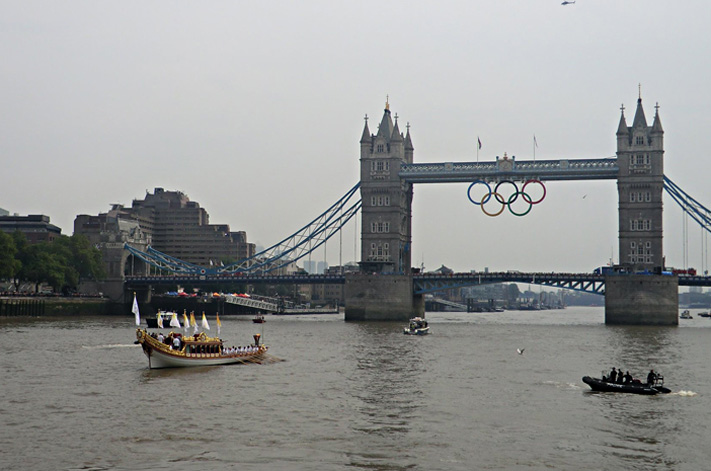
Giant Rings were also placed on Tower Bridge, a bridge inaugurated in 1894, the year they decided to revive the Olympics for the Modern era.
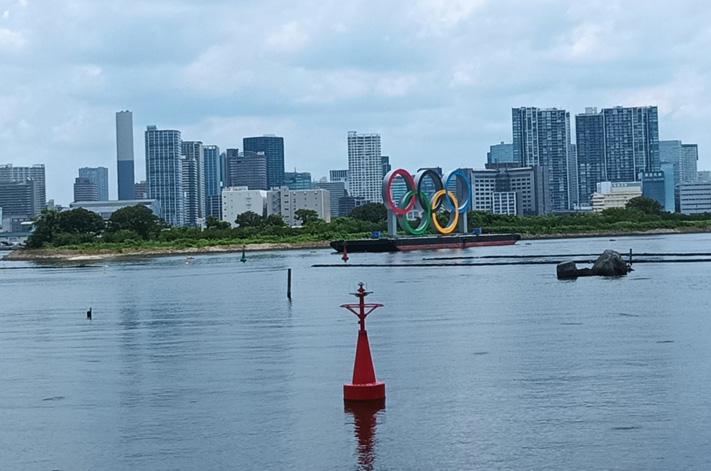
Three years ago at the delayed Tokyo Olympics, Rings were positioned on a pontoon in the Odaiba Marine Park which hosted triathlon and open water swimming.
They could be viewed from Tokyo’s Rainbow Bridge.
It is most likely that the rings were designed by Pierre de Coubertin who was born on New Year’s Day 1863 at Rue Oudinot in the 7th arrondissement in Paris.
The design represents the five continents, but the colours of the Rings do not specifically correspond to individual continents as organisers in some recent host cities, including Sydney and Sochi, have mistakenly claimed.
The significance of the colours is they were intended to include at least one from the flag of every country taking part in the Olympic Games.
In 1924 Paris was the first city to receive a Ceremonial Handover Flag bearing the rings.
This was presented by the city authorities of 1920 hosts, Antwerp.
At that time, the Flag was held by the incumbent host city for four years after staging the Games.
There are no comments published yet.