
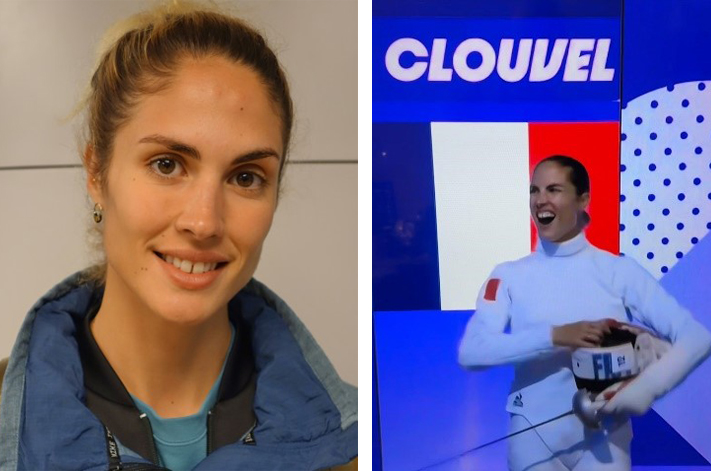
 Elodie Clouvel competing in her fourth Olympics at the 2024 Paris Games.
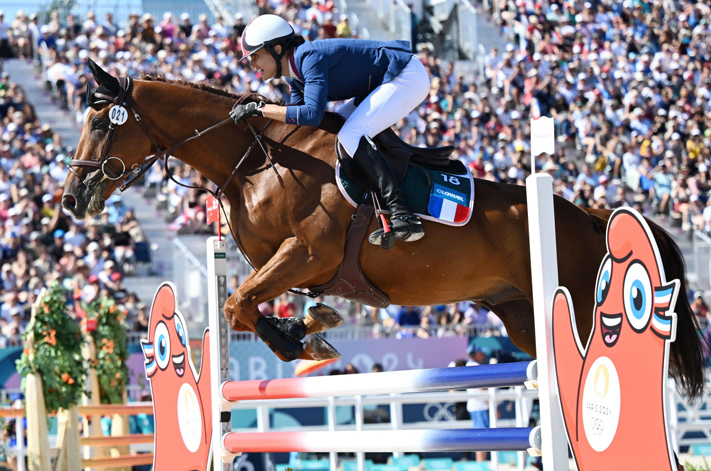
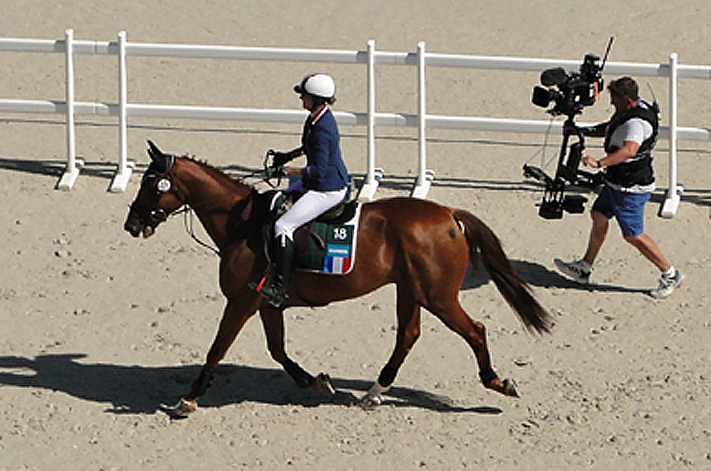
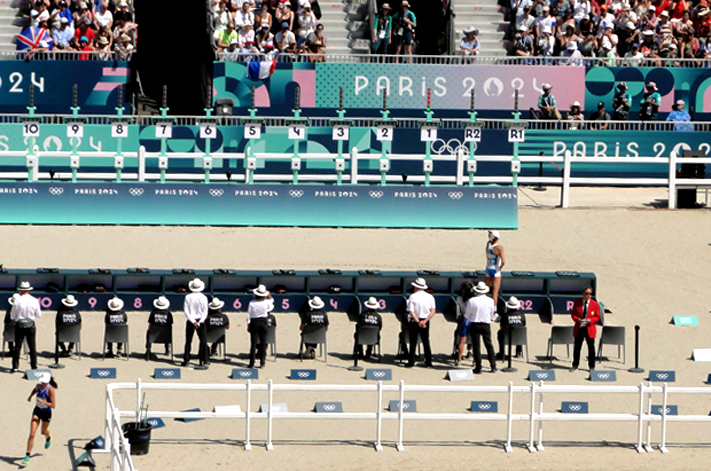
Élodie Clouvel, The Olympic Modern Pentathlon Rider
by Tom Lough OLY and Kevin Witherspoon
The women’s gold medal in modern pentathlon was decided on the final day of the Paris Olympics. It will forever hold a significant place in the sport as it was the last modern pentathlon to feature riding as the sport will include the discipline of obstacle racing in 2028.
The last rider was Élodie Pascaline Clouvel of France, Rio 2016 Olympic silver medallist and competing in her fourth Olympics at the age of 35.
A member of the French military, she was considered a strong medal contender on home soil, along with her compatriot Marie Oteiza.
36 men and 36 women from 31 countries were able to compete. France was one of ten countries with the maximum of two men and two women. Qualification was based on International Modern Pentathlon Union (UIPM) standings and some regional quota places.
This informal but detailed account of Clouvel’s competition is designed to give the reader an impression of what the actual experience was like.
The Olympic modern pentathlon competition of the last rider, Élodie Clouvel and her rivals at Versailles was dramatically different from that of Kai Jølver and the others who took part in 1912.
ISOH is committed to making information available across as many formats as possible and this article supports a wider assessment of the history of the sport at the Olympics may be be found in Journal of Olympic History issue 3 for 2025.
What is clear that the competition experience of Paris 2024 Paris Olympic Games, was dramatically different from that of Denmark’s Kai Jølver, the first modern pentathlon rider in 1912.
About the 2024 Modern Pentathlon
The Paris 2024 Olympic Modern Pentathlon was contested over a period of four days, 8 – 11 August.
The official spectator brochure available online described the competition as “made up of four events and five sports: riding, fencing, swimming and laser run (running and shooting). The results for fencing (ranking round competed the previous day then bonus round), riding and swimming determine the starting positions for the last event – the laser run. Athletes start at intervals corresponding to the number of points between them and the leader. The winner is therefore first to cross the finish line.”
Housing
An Olympic Village with accommodation for 15,000 athletes was available a few kilometres from the city centre for the 2024 Olympic athletes of all nations. This was situated within 30 minutes of travel of the competition venues. Access to the village and venues was tightly controlled to ensure the safety of Olympic participants.
Administration and Scoring Competitor numbers were issued according to the ranking for each event after the ranking round in fencing.
In 2024, a competitor earned points for each discipline based on scoring tables keyed to performance levels, with the final order of finish overall determined by ranking the total number of points earned for all five disciplines. The final order of finish in the laser run was also the final order of finish overall, following the methodology described below.
Getting Started
The fencing in modern pentathlon is the only discipline of the five in which one competitor can directly affect the score of another. A round-robin format of bouts pits all competitor against each other. From a two-day schedule in 1912, the format had altered to the extent that fencig in 2024 took the form of a one-day “ranking round” prior to the semifinals and finals. Fencing in the semifinals and final was conducted through a “bonus round,” in which fencers competed for a few additional points in very short bouts through a direct elimination process.
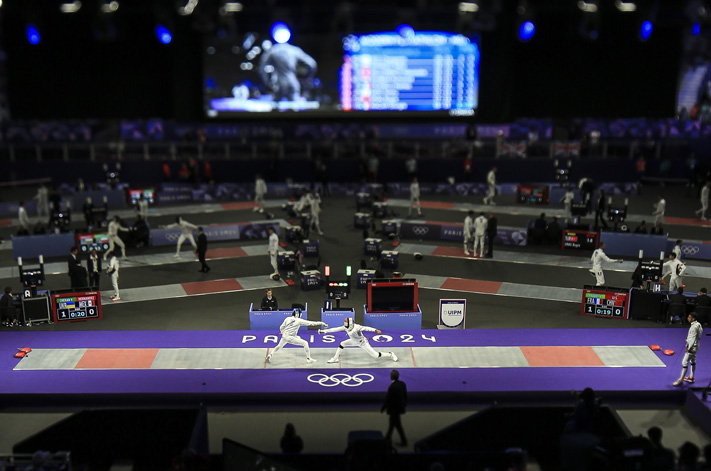
The ranking rounds for men’s and women’s modern pentathlon fencing were contested at the Paris Arena North in Villapinte on Thursday, 8 August. This was an arena which had previously staged boxing during the Games. The floor area had been reconfigured with nine fencing pistes labelled from A to I. Spectators were seated in elevated temporary stands on all four sides.please insert map of fencing pistes here
Each piste had take up reels at each end for connecting to the electrified epees of the competitors. A central display on each piste with red and green scoring lights to indicated hits, a readout of the clock , and information on the names and countries of the competitors.
Piste I was the highlighted strip with special illumination for television broadcast cameras. All competitors fenced on this piste at least once with the exception of the two Hungarians who fenced exclusively on Piste A for the duration.
At about 2:30 P.M., the women were individually introduced with a backdrop displaying their names and respective national flag. Unsurprisingly, Clouvel and Oteiza both received an enthusiastic reaction from the home crowd.
At around 2:35 P.M., Clouvel was called to the strip to fence against her compatriot in the first 35 one-touch bouts, each allotted maximum time of one minute. (In each case,competitors from the same country were required to fence each other in their first bout.) Clouvel had met Oteiza on the piste many times in the past, and in this bout she defeated her familiar rival. As the afternoon wore on all the competitors rotated throughout the nine pistes, eventually facing everyone else in the round-robin competition.
The one-touch one-minute fencing bouts went quickly and Clouvel had only two or three minutes between bouts. She alternated between sitting to rest and stretching to stay warmed up. She drank water frequently to stay hydrated and consulted with her coach as they analysed the competitors she would fence next.
At the end of the ranking round, the standings formed the basis of the order of the two groups of 18 (A and B) for the semifinals on 10 August. Clouvel fenced very well and won 27 of her 35 bouts, which gave her 260 pentathlon points (25 wins = 250 points plus five points for each additional win) This put her in the lead after the ranking round. Michelle Gulyas of Hungary was a distant second with 24 victories and 245 points.
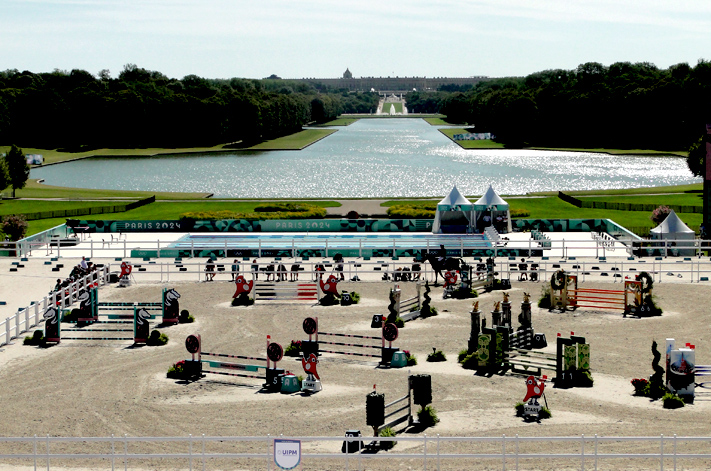
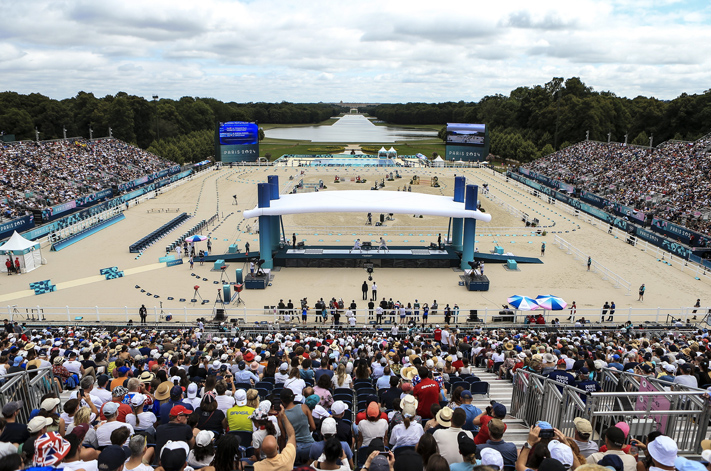
The men semifinals and finals were scheduled for August 9 and 10 and women’s competitions for August 10 and 11. These phases were all held at a specially constructed venue in the grounds of the Château de Versailles, 35 kilometres west of the centre of Paris. [Figure 9] After a rest day, the women pentathletes returned for their semifinals, which began with the equestrian competition and the riders starting in inverse ranking round order. This meant that Clouvel would be the final rider in her semifinal competition. Astute observers soon realised that, if she advanced to the final, she would also be the last Olympic modern pentathlon rider, closing out the horse era.
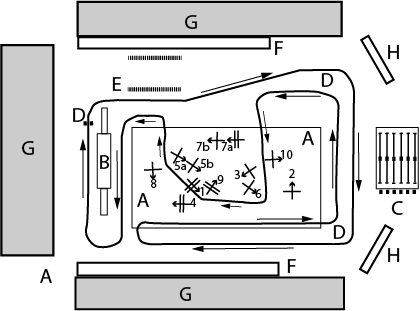
The modern pentathlon venue was located at the west end of the formal gardens. Areas for each of the five disciplines were arranged in a stadium-like setting with stands on three sides to accommodate 15,000 spectators. From just about any seat, spectators could observe the horse-riding (A’s in diagram), fencing (B), swimming (C), running (D’s) and shooting (E). Changing stations (F’s) were installed for the competitors. Two large video screens (H’s) showed spectators the television broadcast feed.
The 36 competitors had been split into semifinal groups A and B of 18 women each and placed in the inverse order of their ranking round results. Clouvel was in semifinal Group B, with a fencing ranking round number of 1. She was issued semifinal identification number 18, making her the last rider. Her horse was allocated by the drawing of Lots. She was to ride number 35, “Fer de Lance,” and was encouraged to learn that Lukasz Gutkowski of Poland had ridden the same horse to a perfect score the day before in the men’s semifinals.
The Group B women’s semifinal riding competition began at about 1:30 P.M., starting with the 18th place competitor, and the next rider starting one minute and 45 seconds later. She watched the first couple of riders and then waited in the warmup area.
At about 1:40 she was allowed to mount Fer de Lance and begin her warmup in a small ring behind the stadium. She needed only four of the five permitted warmup jumps to tell her what she needed to know about her mount. At about 2:00, she entered the stadium and waited for the bell to begin. She had studied the configuration of the ten fences on the course through the 400 metres and ten knockdown obstacles (between the two central A’s in the diagram) until she must have felt she could do it in her sleep. She rode well but knocked down rails at 5b and 7b, resulting in 14 penalty points and a riding score of 286 pentathlon points (300 base points less 14 penalty points).
As soon as she crossed the finish line, she patted her horse as required by the rules, dismounted, and went to her changing area. She suited up for the fencing bonus round ( B in the diagram). The one-touch bouts had a 30-second time limit. Fencing started at 2:10 P.M., with the first bout between the competitors 1 and 2. The winner stayed on the strip to face the next competitor, and so on in a direct elimination process. As fencer number 18, Clouvel waited until all of the bouts between the earlier competitors were finished. Then she faced number 17, Gulyas from Hungary, and defeated her, adding four bonus points to her ranking round score of 260 to give her a total fencing total of 264 pentathlon points. Her total score for riding and fencing was thus 550 points, which meant she remained in the lead overall.
As soon as her fencing was finished, she changed into swimming gear and walked with the confidence of a strong swimmer down to the pool area (C in the diagram).
Each swimming heat was over 200m, (eight lengths of the 25m pool) The officials confirmed her suit was in compliance with World Aquatics regulations.
Clouvel was drawn in heat three and was to swim in lane one with other top five competitors to the end of the pool with the starting blocks and completed brief series of on-land warm up exercises, as no warm up in the pool was permitted.
The swimmers were introduced individually by loudspeaker and video screens. Then, at about 2:50 P.M., she mounted the starting block and waited for the starting signal.
She swam well finishing just behind Gulyas of Hungary with an excellent time of 2:12.74, which gave her 285 pentathlon points (250 base points plus one point for every half-second faster than 2:30.50).
Her total score after three events was 835 pentathlon points, which put her first place in semifinal Group B, leading Gulyas in second place with 823 points. With such a high placing after three events, she could afford to relax a little in the laser run and save some of her strength, knowing that all she had to do was to finish in the top nine to advance to the finals the next day. The competitors who were lower down the field could not afford to relax if they intended to advance.
Clouvel changed into running gear and pinned a panel with the number “1” onto the front of her jersey. She picked up her laser pistol and her spare and went to the shooting area (indicated on the diagram as E), set up in shooting booth one, put her spare pistol on the bottom shelf, and went through her shooting and warmup routine. She also jogged around part of the running course. At about 3:05 P.M., she went to the start/finish area (extreme left at D) and checked in with the laser run clerk.
At 3:10 P.M., the laser run began. As Clouvel was in first place after the first three sports, she was the first away. Gulyas started 12 seconds behind her, since she had a three-sport score of 823, 12 fewer pentathlon points. The remaining runners followed at similarly staggered intervals. Clouvel ran once around the 600m loop and then stopped at booth one on the shooting line to fire her laser pistol.
For each shot, she loaded her pistol by raising a small lever on it, tapped the tabletop with the pistol barrel, then raised the pistol and squeezed the trigger to fire. She had to fire at the 59.5-millimetre round target until she hit it five times or until 50 seconds elapsed. Five LEDs mounted above the target 10 meters distant changed from red to green one at a time to signal as each target was hit. When five hits had been registered, all of the LEDs blinked several times, indicating that she was released to run another 600-metre lap.
She had quite a few misses on her first shooting series and Gulyas finished shooting ahead of her. After the second shooting series, Clouvel was in third place, 23 seconds behind Gulyas and 17 seconds behind Kim Sun-woo of South Korea. After the third shooting series, she ran past Kim and into second place, now 17 seconds behind Gulyas. By this time, Clouvel and Gulyas both were aware that they would make the finals, and they began to relax. Clouvel did very well on her fourth shooting series and caught up with Gulyas. As they approached the finish line, they were joined by Laura Heredia of Spain, Blanka Guzi of Hungary, and Kim.
They crossed the finish line (extreme left D in the diagram) together. The next five finishers battled for the other positions in the top nine, all finishing within ten seconds of the leaders.
Sunday, 11 August followed the same sequence as Saturday for Clouvel. As it was the medal round, there was of course more pressure. Once again, she was ranked first out of the 18 finalists For the final, everyone started from scratch. The only points they carried forward were from the fencing ranking round. In Clouvel’s case this was 260 points.
This time she drew horse was number 21, “Fly de Vesquerie, which came from the stables of the Republican Guard, and waited until her mount time as the last rider. She learned by coincidence Gutkowski had also ridden Fly de Vesquerie in the men’s finals for 286 points, with seven penalty points from a knockdown at 7a and seven from a knockdown at 10. The horse also hit a top rail at 5a, but it did not drop.
At about 9:40 she mounted her horse and entered the warmup ring. At about 10:00, she approached the starting line and waited for the bell to begin, much as Jølver had done, 112 years before. At last, her moment came. It was so nearly a clear round only fence 8 down. She was greeted with a loud cheer as she crossed the finish line by clearing the final jump, scoring 293 pentathlon points (300 points less seven penalty points for the knockdown).
“That’s an emotional end. That would have been the final ride ever seen at an Olympic Games in modern pentathlon. A moment in history.” said Heather Fell, commentating for NBC> Thus ended the Era of the Horse in the history of the Olympic modern pentathlon.
Clouvel patted her horse dismounted, and suited up for the fencing bonus round, following the same process as in the semifinals the day before. Fencing started at 10:10 A.M. When her turn came, she fenced only one bout, against a competitor from Italy, which she won. This gave her four bonus points (because of her first-place ranking) and a total of 274 fencing points. Her total after the fencing and riding was 557 points so she had maintained her lead.
She changed into her swimsuit and swam in the third heat. From lane one she recorded a time of 2:11.64, which gave her 287 points.
In the overall standings after three disciplines, she had 844 pentathlon points to lead the field.
She changed into running gear, pinned on a bib with “1” , and went over to the running area. She set up her laser shooting station in booth one and jogged to warm up. She was the first runner to depart, 13 seconds ahead of Gulyas of Hungary. Once again, Clouvel encountered trouble on her first shooting rotation allowing Gulyas to take a six-second lead. On the next shooting rotation, she shot better but dropped back to third place. On the third shooting rotation, Clouvel missed a couple shots but then hit five in a row. Gulyas was still six seconds ahead with Clouvel still in second place. After the fourth and final shooting rotation, the first five competitors had intervals of about ten seconds between them, which did not change appreciably during the final lap. Gulyas crossed the line first for gold Clouvel finished in second to take silver with a time of 11:32.35, giving her 608 pentathlon points (500 points plus 1 point per second faster than 13:20) and a total of 1452 points, nine points behind Gulyas.
Although she missed out on gold medal, Élodie Clouvel had nonetheless secured a place in history as the final Olympic modern pentathlon rider. When she crossed the finish line on Fly de Vesquerie after her round in the equestrian phase, it marked the end of the Era of the Horse for the Olympic modern pentathlon.
Afterwards she spoke about the ride.
“I will forever remember this moment. … I was with my horse on the last jump. I literally flew with him through the whole course. He was amazing. I thank him. His name is ‘Fly’. … I was so much in the moment with my horse. It was my last course. It was magic. I will never forget that horse.”
In addition to our website, you can also find information on Olympic history, personalities and stories on our social media platforms facebook, twitter and instagram @ISOHOlympic and Via Linked at LinkedIn: isoh.org/linkedin
There are no comments published yet.