
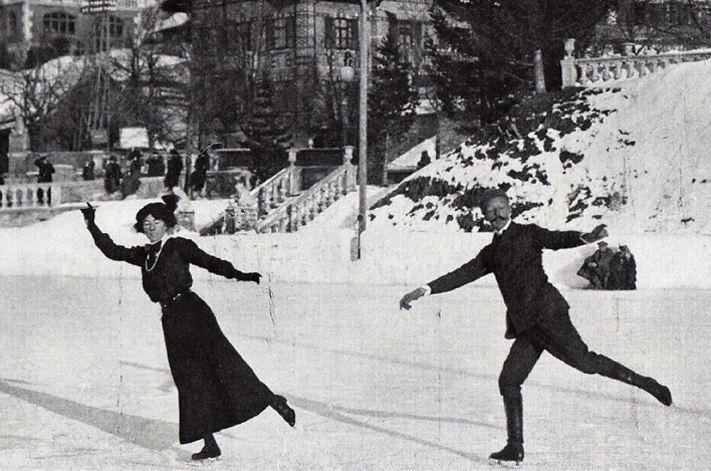
 Madge & Edgar Syers, British figure skaters.
Olympic Winter Sport Began in Kensington
By Philip Barker in Knightsbridge, London
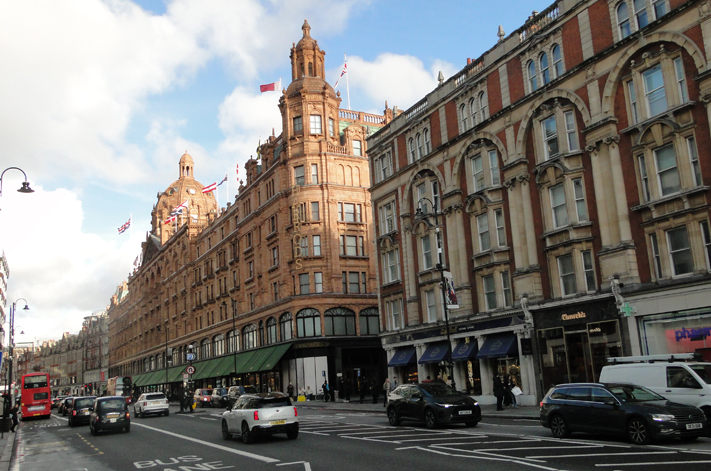
The Milano Cortina Opening Ceremony next Friday is set to include a sequence marking a century of Winter Olympics but in fact the first Olympic gold medal on ice was awarded 18 years earlier after competitions at a rink in London’s fashionable Knightsbridge district.
Figure skating events were included in the 1908 London Olympics as part of a programme of winter sports which also included hockey, lacrosse and football. They all took place in the month of October to conclude the Olympic competition which had begun in April.
The sport of ice skating had been growing in popularity by the end of the 19th century. The International Skating Union had been established in 1892 at Scheveningen in the Netherlands. It was one of the first international governing bodies to be established and the first to administer a “winter sport.”
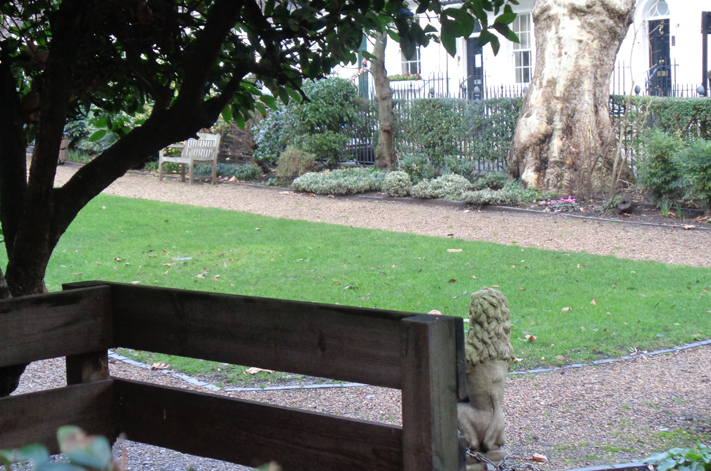
A few months after the first Olympic Games of the Modern era in Athens, the Princes Club Ice skating ring was opened near Hyde Park in an area close to Montpellier Square and Trevor Square,
In its heyday it was a popular arena and later staged events for the women’s suffragette movement which was appropriate because one British skater played her part in developing the sport for women.
Her name was Florence Syers, known to friends as “Madge.” She had begun skating with husband Edgar in the pairs. In 1902 she entered the World Championships when they were held in London at the Niagara rink in Westminster. There were no competitions for women so she entered the men’s event. She was beaten only by the great Swedish champion Ulrich Salchow.
“Many English women have become remarkably proficient, equal indeed to any but the very best of the other sex” wrote Syers later. “Skating is particularly Appropriate for women it requires not so much strength as Grace combined with a fine balance and the ability to move the feet rapidly.”
Her exploits prompted the ISU to introduce a category for women.
When London took over the hosting of the Olympic Games figure skating was included on the programme. London’s proposals were approved at the 1907 International Olympic Committee (IOC) session in The Hague.
This also agreed that “winter sports” were to be completed in April and the remainder of the programme in July.
In fact, although racquet sports such as jeu de paume were held in April, the other winter sports did not happen until October.
The National Skating Association (NSA) of Great Britain was put in charge of organisation. NSA President William Hayes Fisher, (later Lord Downham) chaired the subcommittee which included NSA Secretary Edgar Syers. He was also to compete at the Games. It was not unusual in those days for those competing in the Games to also take a role in their administration.
The Princes Skating Club was selected to host the event.
“Through the goodwill and assistance of the Duchess of Bedford the rink at Prince’s Skating Club was specially opened for the practice of competitors,” said the official report.
It may seem incredible in an era when all Olympic venues are “locked down” for security reasons but in 1908, the rink was open for public use when not required by the Olympic competitors.
The competition was held under strict amateur regulations.
The regulations banned anyone who “practised in his own person any sporting bodily exercise as a means of gain” or if they “practised or taught skating for money,” “sold or pledged prizes won in sporting competitions,” or “knowingly and without protest started in an open skating competition against a competitor who is not an amateur according to these regulations.”
Only around 20 competitors from six nations fulfilled these strict conditions.
The lowering of a flag by an official signalled the start of a routine and “every minute gone is announced to the skater by the call, One, Two, etc., and by putting up the corresponding numbers,” stipulated the rulebook.
Competition began with compulsory figures in the “ladies” competition. The Field Magazine reported: “It was soon apparent that Mrs Syers, after a year’s retirement from competitions, is still in a class by herself.”
In the men’s events, Salchow went into the lead. The following morning, the men were back on the rink for the “Special Figures,” held for the only time in 1908.
Each figure skater was to be marked “in accordance with its supposed difficulty and novelty.”
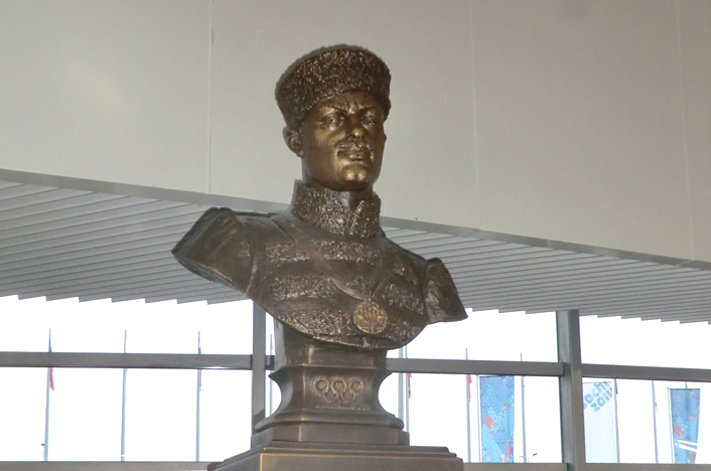
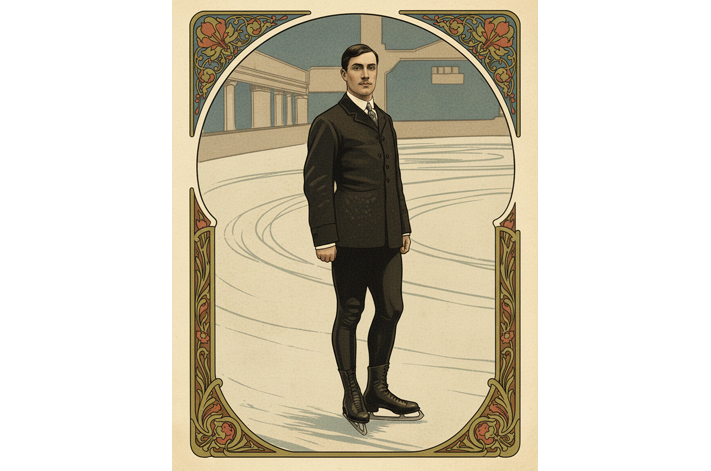
It was the first gold medal to be decided. The winner was Russian skater Nikolai Kolomenkin, who used a nickname, “Panin,” possibly because skating was not considered entirely respectable in polite society.
The official report described his efforts “as far in advance of his opponents, both in the difficulty of his figures, and in the ease and accuracy of their execution.”
The man from The Times newspaper took a more critical view.
“The casual spectator is apt to find these tedious,” he wrote.
“The rink was filled to overflowing with an enthusiastic crowd of onlookers, who witnessed perhaps the most strenuous, delightful and varied display of figure skating that has ever taken place,” wrote Sir Theodore Cook in the official report of the Games.
The Sporting Life newspaper countered that skating “had not yet excited the great British public.”
In the individual competitions, Syers duly completed her victory to become the first woman to win gold in women’s winter sport and Salchow took the men’s title.
Although organisers insisted there was “an excellent and representative entry,” a late withdrawal meant there were only three entries for the pairs competition won by Anna Hubler and Heinrich Burger of Germany.
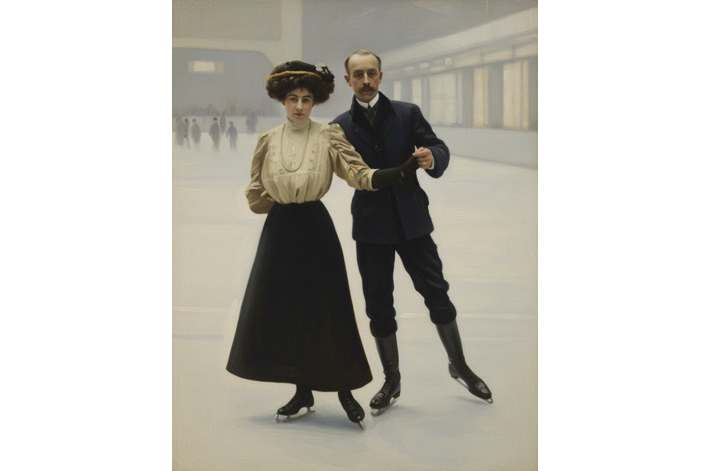
Great Britain’s Phyllis Johnson and her husband James took silver, and Madge returned with her husband Edgar to claim bronze.
Sadly, Madge suffered ill health in later years and died aged only 35 in 1917.
There was no Closing Ceremony in 1908. Instead, there was a banquet in Holborn, attended by Salchow and some of the overseas skaters still in London.
Lord Desborough, Chairman of the Organising Committee described skating as certainly “not the least successful and was decidedly the most graceful.”
There were plans for a Winter sports week to be held in the Black Forest at Berlin’s 1916 Olympics, never celebrated because of the first world war. When normal sport resumed, skating and ice hockey were included at the 1920 Games in Antwerp.
In 1924 came a Winter Sports week in Chamonix with the trappings of an Olympic event and an oath was taken on behalf of the other athletes by Camille Mandrillon, a competitor in the military patrol event, a forerunner of biathlon.
The following year a technical congress took place in Prague as part of a series of Olympic meetings following the session. During the discussions there were “Special questions concerning winter sports, suggestion as to a distinct cycle.”
There was general support for this. The sports to be included were skiing, skating, ice hockey, bobsleigh and toboggan.
It was hoped that there might also be demonstration in skeleton and skijoring where skiers are pulled behind a horse.
It was also requested that the events in Chamonix be designated as the First Winter Olympic Games.
In Lisbon the following year the IOC approved the decision by 21 votes to two.
President Comte Henri Baillet Latour told his colleagues “Encouraged by the brilliant success of the Games of Chamonix, the eager experts in winter sports have, on their side, determined to celebrate in future the return of each Olympiad.”
The future of Games on ice and snow was assured.
In addition to our website, you can also find information on Olympic history, personalities and stories on our social media platforms facebook, twitter and instagram @ISOHOlympic and Via Linked at LinkedIn: isoh.org/linkedin
There are no comments published yet.