
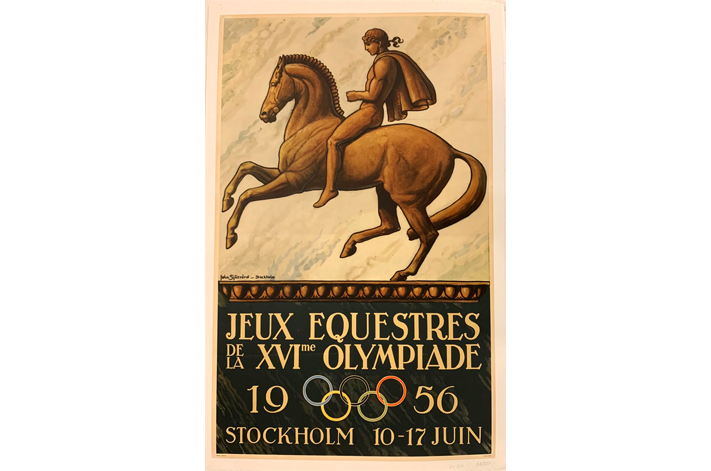
 Official 1956 Equestrian Olympics Poster
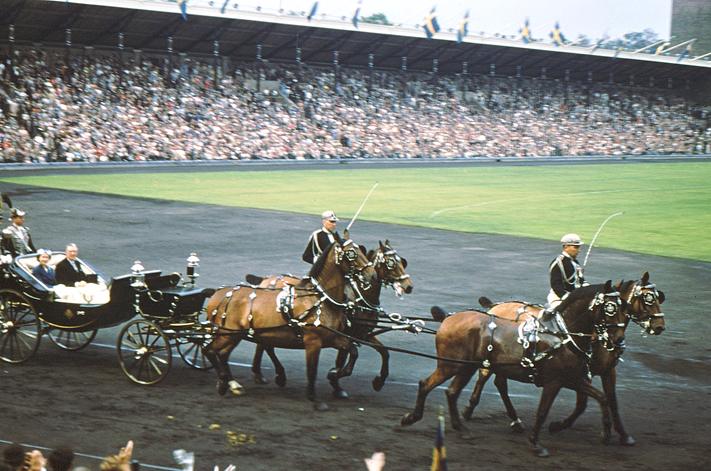
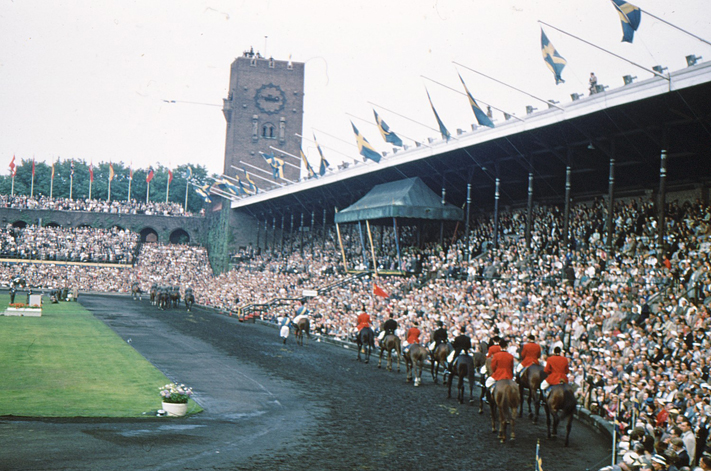
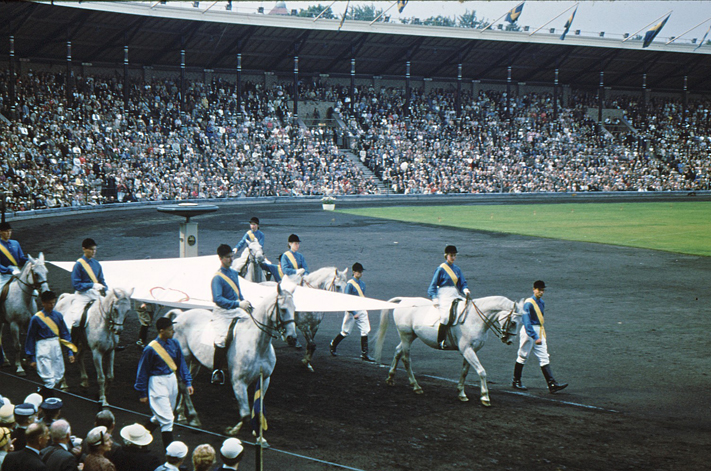
1956 Equestrian Olympics 70th Anniversary
by Philip Barker
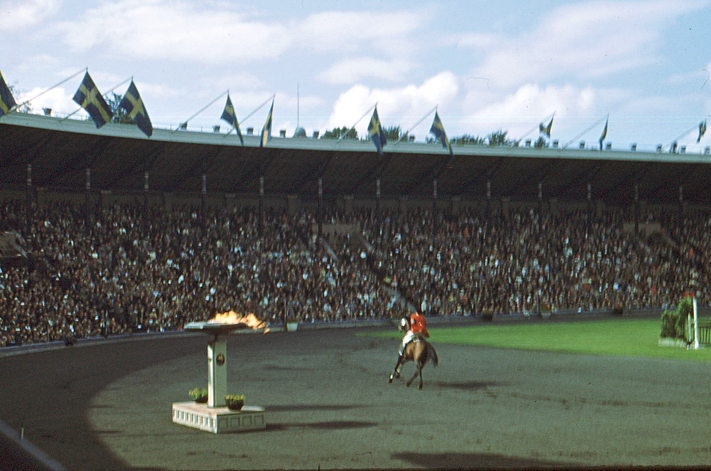
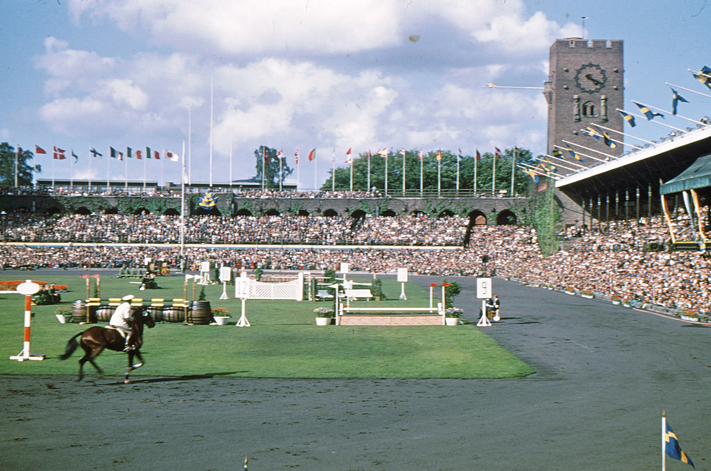
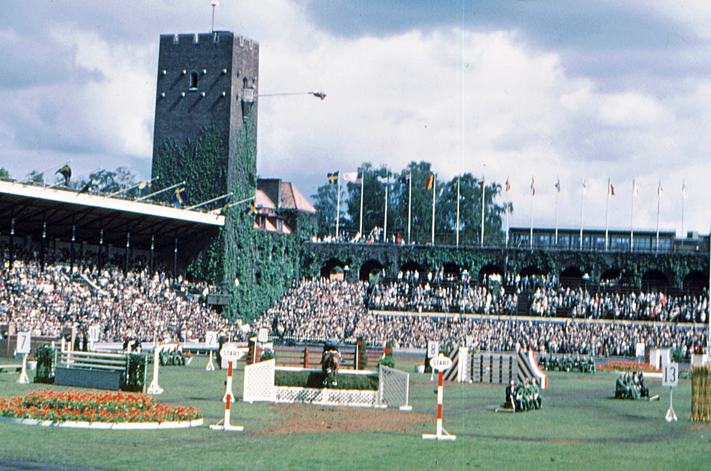
A cache of rarely seen colour photographs from a private collection depicts the Olympic equestrian competitions exactly 70 years ago.
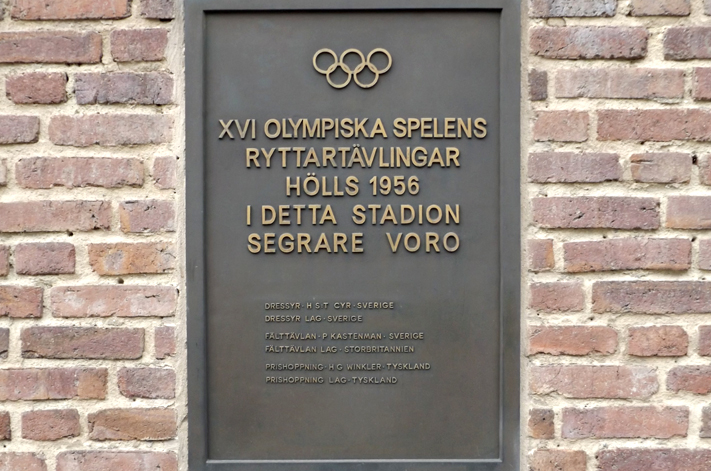
They were held in Stockholm’s historic stadium in June 1956.
The Olympics were scheduled for Melbourne, Australia, but strict quarantine laws made an equestrian event impossible so the competition was switched to the Swedish capital.
Melbourne had been awarded the Games in 1949 and dressage was planned for the Melbourne showgrounds on the outskirts of the city. The three-day event “across open country, roads etc.” was to be “in accordance with the regulations of the International Equestrian Federation.”
Then in 1953, came a bombshell from Australian IOC member Hugh Weir.
“Only one worry preoccupies us, it is the quarantine of six months imposed by an Australian law on all the foreign horses coming.” Weir said.
Olympic officials asked if an exception could be made but Australian health minister Sir Earle Page responded
“No exceptions should be made to enable horses to enter Australia for the purpose of taking part in the Olympic Games.”
The International Equestrian Federation (FEI) asked the IOC to find an alternative host.
Lord Killanin threw Dublin’s hat into the ring and West Berlin proposed facilities used in 1936.
When the IOC met in Athens, IOC Vice President Lord Burghley told his colleagues, “It is our duty to look to the future, begging our Australian friends to forgo the project of organising the equestrian events.”
The IOC received a telegram from the Swedes.
“Stockholm had the honour to arrange the first equestrian competitions in 1912. We think that is one of many good reasons for giving Stockholm also the sole Olympic equestrian competitions of 1956.”
In the final vote, Stockholm received 25 votes to beat Paris, Rio de Janeiro, Berlin and Los Angeles.
In Stockholm, a contingency fund of 200,000 crowns was set aside and an Olympic lottery and philatelic programme supplemented ticket sales.
Riders and grooms were given living quarters in two military colleges but reassured that “in no cases will there be more than two beds in each room.”
Hellenic Olympic Committee President Constantinos Georgacopoulos offered to send a Flame from Olympia. “The HOC has come to this decision taking into consideration the exceptional situation of force majeure.”
It travelled through Copenhagen, where it was carried by Lis Hartel, a dressage silver medallist at the 1952 Olympics in Helsinki.
When the Relay crossed into Sweden, women’s auxiliary groups and riding clubs provided riders and the Flame was carried toward Stockholm through the night. More women had participated in the Relay than ever before.
The final bearer was dressage competitor Hans Wikne who rode in to light the cauldron.
The official ceremony protocol then described how “the Olympic Fire will be carried from the brazier by two runners up to the top of the two stadium towers where beacons will be lit.”
The bearers were Henry Eriksson 1,500m gold medallist at London 1948, and 1952 gymnastics champion Karin Lindberg. Both wore white vests bearing the Olympic rings. Lindberg was the first woman to carry an Olympic Flame in the stadium. Her role is often forgotten in Olympic history.
The King of Sweden had been installed as patron of the Games. His main guests were the young Queen Elizabeth II and her husband Prince Philip Duke of Edinburgh.
There was great excitement when the Royal Yacht Britannia sailed into Stockholm. The British royals attended a gala dinner on the eve of the Games.
It rained on the morning of the Ceremony but ceased for the Royal procession in open carriages.
The parade of nations was on horseback and some of the horses, unused to the big crowds, gave their riders a few difficulties.
Competition began with dressage.
1952 double gold medallist Henry Saint Cyr, making his fourth consecutive Olympic appearance, repeated his success on a brown gelding, Juli. Sweden also won the team gold. Saint Cyr had also taken the competitors oath.
In the three-day event, rain made the cross country phase particularly testing.
There were many fallen horses and animal rights groups protested to the IOC afterwards. Clad in waterproofs, the Queen and Duke joined Swedish royals to view the competition close up.
The Queen had a personal interest because she owned Countryman V, ridden by Bertie Hill. By the time of the jumping, the British had a clear advantage and duly won gold. The team and officials were invited aboard Britannia in celebration.
Petrus Kastenman won individual gold for Sweden on Illuster.
Women were not yet permitted to take part in eventing but in jumping, Belgium’s Brigitte Schockaert tied for 34th place and British rider Pat Smythe of Great Britain took bronze in the team event on her famous mount Flanagan.
Germany won the team competition and individual gold went to their legendary rider Hans Gunter Winkler on Halla.
When the events came to an end, it was IOC President Brundage who made the closing declaration.
“I offer to His Majesty King Gustaf VI Adolf and to the people of Sweden, to the authorities of the City of Stockholm and to the Organizing Committee of these Games, our deepest gratitude.”
In addition to our website, you can also find information on Olympic history, personalities and stories on our social media platforms facebook, twitter and instagram @ISOHOlympic and Via Linked at LinkedIn: isoh.org/linkedin
There are no comments published yet.