
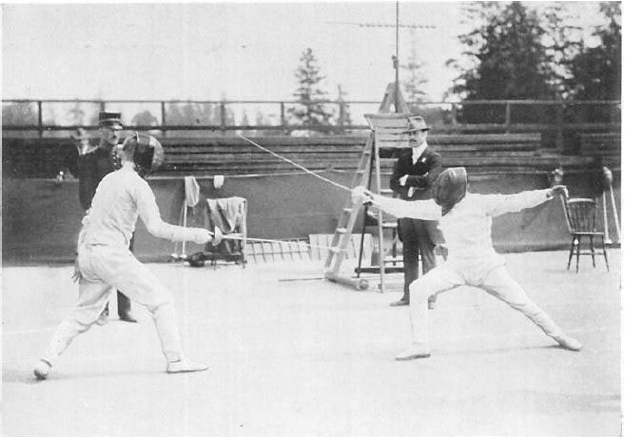
In the 1912 modern pentathlon the fencing phase was held on an outdoor tennis court.
Kai Jølver: The First Rider in the Olympic Modern Pentathlon
by Tom Lough OLY and Kevin Witherspoon
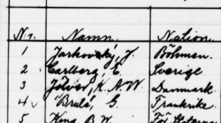
Kai Jølver, no. 3 on the entry list.
This informal account draws on newspaper articles, Swedish Olympic archives, and the report of the Swedish Olympic Committee (SOC) to give the reader an impression of what the experience may have been like for competitors at the first Olympic Modern Pentathlon at the 1912 Stockholm Games,
Kai Albert Wognsen Jølver of Denmark was the first rider at these Games in a competition dramatically different to that experienced by the last rider Élodie Clouvel and her rivals in Paris 112 years later.
About the 1912 Modern Pentathlon
The 1912 Olympic Modern Pentathlon was contested over a period of six days from 7 – 12 July.
The official 1912 modern pentathlon rule book described the event as follows:
“The competition comprises the following events:
Rule book for modern pentathlon in 1912.
I. Duel-Shooting, distance 25 metres. 20 shots in 4 series of 5 shots each. 2 sighters. Target, whole-figure, 1.7 metre high, divided into zones. The target will be visible 3 seconds, with an interval of 10 seconds between each shot. Weapon, any revolver or pistol with open fore- and back-sight.
II Swimming, 300 metres, free style.
III. Fencing. Weapon: Épée.
IV. Riding singly over a special, marked course, not exceeding 5,000 metres. Horses may be provided by the competitors themselves or will, if desired, be supplied by the Swedish Olympic Committee. Competitors not providing horses themselves shall clearly state so at the time of entering.
V. Cross Country Race, ca. 4,000 metres. Competitors start singly, at intervals of 1 minute. Start and finish in the Stadium.”
The modern pentathlon rule book allowed any country to enter a maximum of 12 competitors. Sweden, the host nation, was the only country to do so. Russia sent five, Denmark four, and Great Britain three, with six other countries sending only one or two. Of the 32 competitors, only 22 completed all five disciplines. Denmark’s Olympic modern pentathlon squad included Jølver, Vilhelm Laybourn, Johannes Blom Ussing, and Theodor von Zeilau.
About Kai Jølver
At the time of the 1912 Olympic Games, Jølver was 22 years old.He had graduated from the Danish Army Officers School in 1910 and was commissioned as a second lieutenant. Later that year he was promoted to first lieutenant. By 1911 he was listed in the Danish Army Handbook as a member of the 11th Artillery. In 1912, he was assigned to the School of Gymnastics as a student. It is likely that his pentathlon-related training took place here.
Jølver and his three teammates sent their own horses to Stockholm. They were probably boarded in the competition stables in the Barkarby area, North of Stockholm, the site of the modern pentathlon riding competition.
Housing
There was no Olympic Village at the 1912 Olympic Games. Instead competitors stayed in various hotels, pensions, and other accommodation throughout Stockholm. Jølver stayed at a school called Norra Reallaroverket located at Roslagsgatan 19. This was approximately two kilometres west of the Olympic Stadium. It is likely that the other pentathletes from Denmark stayed there as well. In those days security for the competitors was not such a concern for the organisers.
Administration and Scoring
The 32 pentathletes were each assigned identification numbers. Jølver’s competitor number was three. Their starting order in shooting, swimming, fencing, riding, and running order was established by the drawing of lots.
In 1912, the relative order of the finish was determined by points corresponding to the ranking for each event. For example, a competitor finishing 4th in shooting, 7th in swimming, 12th in fencing, 20th in riding, and 10th in running would accumulate a final score of 4+7+12+20+10=53 points. The competitors with the three lowest scores were therefore winners of the gold, silver, and bronze medals.
Getting Started
Competition began with pistol shooting. This was held on the morning of Sunday, 7 July, at the Kaknäs shooting area, about five kilometres east of the Olympic stadium.
Six competitors in the first heat went to their assigned stations on the firing line at 9:00 A.M. and set up with a variety of pistols.
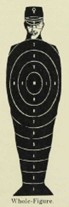 The targets, 25 metres downrange, were “whole figure” turning targets 1.7 metres tall with a drawing of a man’s face on top. The inner ring had a score of 10 points, with the outer rings decreasing in value by one point at a time.
The first heat fired two rounds at the targets for sighting, after which the sighting bullet holes were patched. Next came four series of five shots in competition with a maximum possible score of 20 hits or 200 points.
For each shot, the targets were turned to face the firing line for three seconds. They were then turned away for an interval of 10 seconds between shots, giving shooters with single-shot pistols time to reload. The pistols were held pointing downward and raised up for each shot when the target faced them.
Between each series, the targets were scored, the number of hits recorded, and the holes patched. The final ranking was based first on the total number of hits, with the target score used to break ties.
The Danes each used the same model of the Danish Army pistol, most likely a Bergman model from the 1908/10 series. [photo of pistol if possible]
When the third heat was called to the line, Jølver set up in booth five and completed his two sighting rounds. In the actual competition, Jølver started out terribly, missing the target three times in the first series of five shots. Things got even worse with five misses in the second series. He managed three shots on the target in the third series but recorded only two hits in the fourth and final series. His total score was eight hits out of a possible 20 for 52 target points which put him 32nd and last. [photo of the standings if we can blow it up)
Twelve competitors hit their targets 20 times, with scoring ranging from 172 to 193. Within this group were ties for second, sixth, and tenth places, which were broken by an additional round of shooting with four series of five shots each.
On the morning of Monday, 8 July, the competitors were transported to the specially constructed 100-metre pool at Djurgårdsbrunnviken, about five kilometers southeast of the stadium. They probably arrived around 10:00 A.M., changed into swimming gear there and may have swum a little in the pool to warm up and get used to the water. Most of them used the “Trudgen” stroke (a combination of side stroke and freestyle that was popular at that time), while a few swam the breast stroke.
Jølver was in heat seven so he had to wait more than an hour before being called to the start. He swam the three lengths of the pool in lane four, and finished with a time of 9:32 3/5, which put him 26th.
Later that afternoon, competitors took the 4:25 P.M. train north to Barkarby, where, at 5:00 P.M., they were shown the general terrain for the riding competition and were given a map of the 5,000-metre course. However, they were not permitted to observe any of the 17 fixed obstacles.
It is possible and even likely that the competitors from Sweden were familiar with these, since this area would have made an excellent training ground for them, an indication that the host nation had advantages not accorded to all competing nations. It is a criticism that has long plagued the event.
Those who did not have their own horses drew lots for the available Swedish mounts. Then they returned to Stockholm by train for dinner and rest.
On Tuesday 9 July, the morning was clear and sunny and at 9:00 A.M., they began fencing phase , on two newly constructed outdoor tennis courts at Őstermalm, just northeast of the stadium (In the adjacent tennis pavilion, the Olympic fencing was contested under roof, with the team epee competition going on simultaneously with the modern pentathlon fencing.)
Only 27 took part contesting a total of 351 bouts in the round robin fencing phase. event. During the two eight-hour days scheduled, the two fencing strips, or pistes, were in constant use. [pictures of fencing if we can blow them up)
Each bout ended when one competitor scored a total of three touches on the other and recorded a victory, or when both received a double touch for a total of three touches on each, with defeats recorded for both. For a victory, the number of touches received by the victor was recorded and used later for breaking ties in the final ranking. There was no time limit for a bout, a contributory factor in the overall length of the competition.
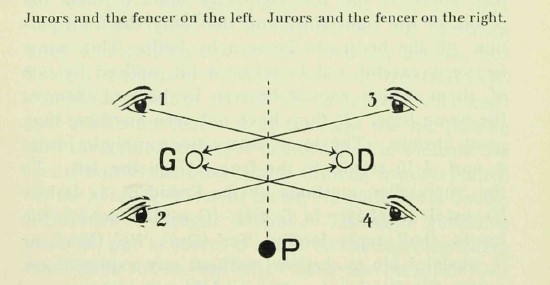
How the judging was done in the fencing.
The judging of hits was done visually, with each bout observed by a director and four judges, who focused on their assigned fencer in pairs. When a touch was observed by one or more judges, the director stopped the bout, consulted the judges, and awarded the touch. In the event of a disagreement among the judges, the director made the decision.
During his two days of fencing, Jølver had to wait an average of about half an hour between bouts. Of his 26 bouts, he received 13 touches in his seven wins. Two of his wins were over strong Swedish fencers. He also recorded four double defeats.
Jølver finished in 22nd place in the fencing event. Two other competitors also had seven wins but were ranked ahead of him because they received fewer touches in their wins.
At breakfast the next morning, Thursday, 11 July, Jølver may well have mentioned to his teammates that it was his 23rd birthday. Later that morning, he took the train to Barkarby with the other competitors for the riding competition. Since Jølver was listed as the first rider to go, he went immediately to the warmup area. He put on his bib with the numeral “3,” checked his horse’s tack, mounted up, and began his 20-minute warmup at 12:00 noon.
Every rider started with 100 points. Penalty points were deducted for refusals and falls, or if the time was too slow. This meant Jølver would have to ride at a speed of 300 metres per minute to avoid the time penalty.
At 12: 20 P.M, Jølver approached the start line and awaited the signal to begin, thinking about the 5,000-meter riding course that lay before him. The fact that he was the first rider ever in Olympic modern pentathlon history probably did not occur to him or for that matter any of the others.
There were 17 obstacles and Jolver and his horse negotiated the first few successfully. They were described as fences and ditches of different kinds, including two fences in close combination going down a steep hill.
According to the scoring sheet,he had a serious problem about two-thirds of the way through, resulting in 12 penalty points. It is most likely that his horse refused the obstacle (2 penalty points) and Jølver fell off (10 penalty points). At the last obstacle he had another refusal, for 2 more penalty points. He finished the course well within the allocated 15 minutes and did not incur a time penalty.
Jølver earned a score of 86 points (100 minus 14 penalty points), which put him for 21st in the riding and 22nd overall after four events. It is quite possible that in Denmark, he had never trained over courses and obstacles as difficult as those presented in the modern pentathlon competition.
That evening, it is possible that his teammates hosted a birthday celebration for him, because he was born on 11 July 1889, making him 23 years old. The era of the horse had begun on the birthday of the first rider.
The Olympic Stadium had been used for the opening ceremony and all track and field events. It was designed by Torben Grut, a renown Swedish architect, whose son, William (Wille) was to become an Olympic modern pentathlon champion and International Modern Pentathlon Union (UIPM) Secretary General. The stadium was only a short distance from the lodgings of the modern pentathlon competitors from Denmark.
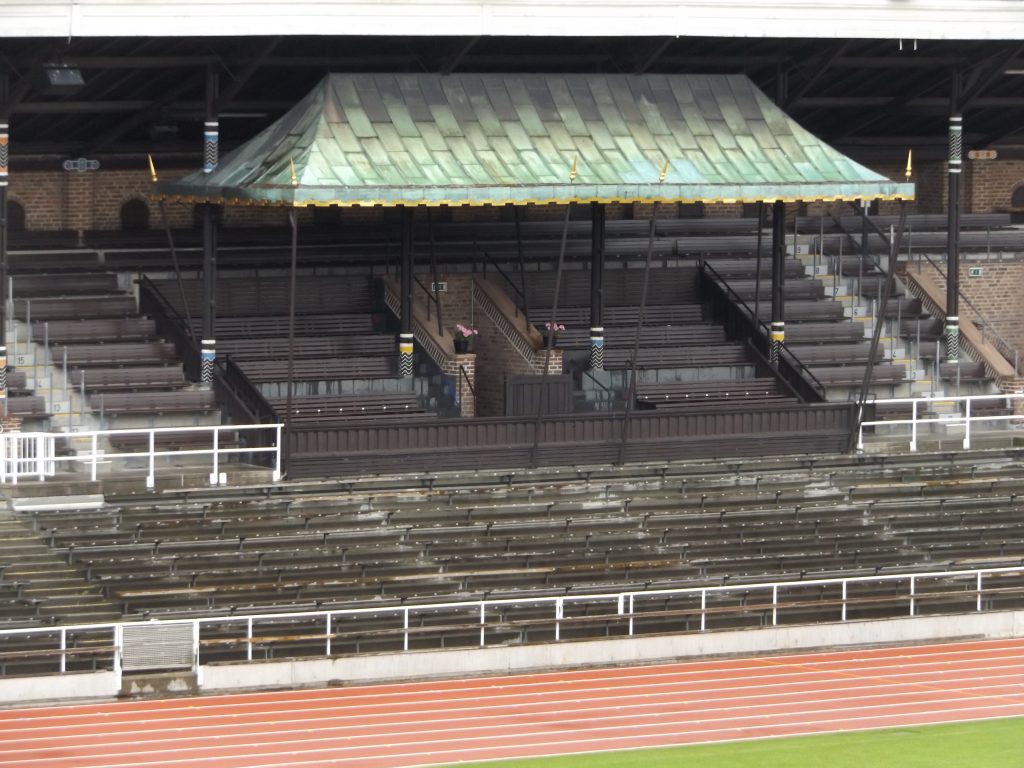
The cross country finished in the stadium near the Royal Box.
On the morning of Friday, 12 July, Jølver and the others warmed up in the stadium in preparation for the final modern pentathlon competition a run of 4000m. The course started in the stadium and then went out one of the gates and into the wooded area nearby. The course returned to the stadium with a finish in front of the viewing stand. None of the competitors had been shown the details of the running course beforehand, although again, the Swedes were probably already familiar with the area.
At 11:00 A.M., the first runner was off, with the others starting at one-minute intervals. Jølver was originally scheduled as the 15th runner but because eight competitors had already dropped out, he was the seventh to start. He set a slow pace, allowing three runners who had started behind him to finish ahead of him. Jølver’s time exceeded 26 minutes, the slowest of all the runners, and he was ranked in 22nd.
For the final ranking, the numerals of his five finishing places were added together for a total of 123 points. This put him in 22nd place, the last of those who completed all five events. Even so, Kai Jølver and his horse earned their place in history as the first to compete in the Olympic modern pentathlon riding, marking the beginning of the horse era.
On Sunday, 14 July, Jølver joined most of the modern pentathlon competitors and members of the Swedish Olympic Modern Pentathlon Committee for a farewell dinner at the Hasselbacken restaurant. Toward the end of the dinner, someone passed around a menu to be autographed. Jølver signed it near the lower left corner of the left page. His signature may be seen one row from the bottom. The dinner served as a social closing ceremony for the first Olympic modern pentathlon.
The Era of the Horse had begun.
In addition to our website, you can also find information on Olympic history, personalities and stories on our social media platforms facebook, twitter and instagram @ISOHOlympic and Via Linked at LinkedIn: isoh.org/linkedin
There are no comments published yet.