
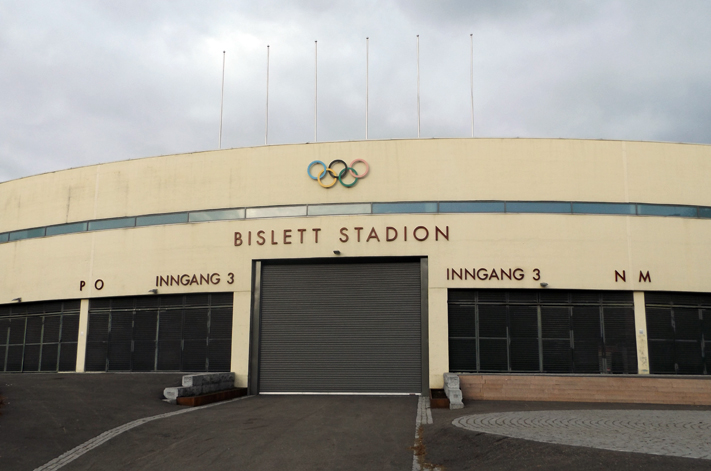
 1952, the approach to the Bislett where the first winter Torch Relay concluded.




By Philip Barker
1,200 bearers are expected to carry the Olympic flame this week as it makes its way to the Bird’s Nest Stadium for the 2022 Opening Ceremony.
It will present quite a contrast with the epic Beijing 2008 Relay which lasted 138 days.
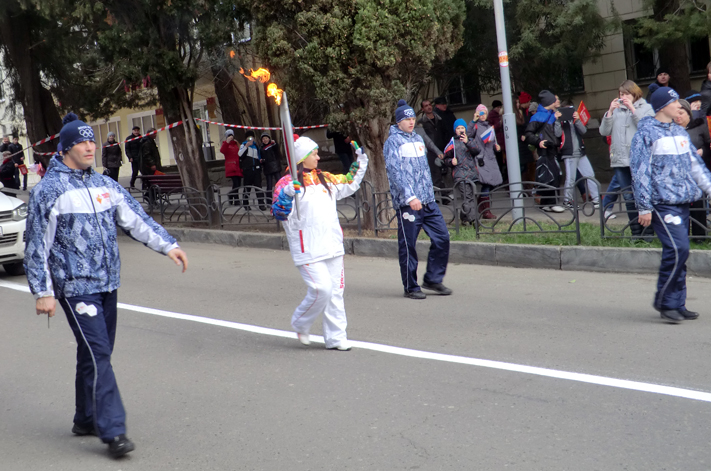
Even for the Winter Games, recent Relays have been a colossal scale. Four years ago, the Flame toured South Korea for over a hundred days, and before that the journey to Sochi in 2014 crossed the vast lands of Russia for 123 days.
Because of COVID measures, Beijing’s 2022 Torch will be one of the shortest domestic journeys in Olympic history.
The first Winter Relay, to Oslo seventy years ago, was even shorter.
In fact, purists do not even consider it an “Olympic” Flame, for it was not lit in Olympia but in the remote village of Morgedal in Telemark.
The idea came from a local teacher called Olav Bjaaland.
“This was no Olympic Flame being carried from Morgedal to Oslo, but a torch greeting from the cradle of Modern skiing,” organisers insisted.
The flame was to be lit at the “modest” woodland cottage of Sondre Norheim, considered the father of modern skiing. This was in Øverbø, a short distance from Morgedal.
It was intended that the arrival of the Flame in Oslo should “mark a definite and festive introduction to the Games.”
Torches were made of a brass and steel alloy. Each was inscribed with the Olympic Rings and an arrow indicating the journey from Morgedal to Oslo. Only 95 were made, which makes them amongst the scarcest.
A special fuel ensured “a continuous fire regardless of wind and precipitation.”
The Flame was lit by 79-year-old Olav Bjaaland, sole surviving member of Roald Amundsen’s historic 1911 South Pole expedition.
Outside, Øystein Strondi, a leading sports official in Morgedal handed the Torch to the first skier Olav Hemmestveit, the son of another distinguished Morgedal skier.
The relay followed the route taken by skiers to reach Oslo many years before.
Two days later, the Flame arrived in Oslo. Eigil Nansen, the grandson of another revered Norwegian explorer, Fridtjof Nansen, ignited the cauldron at the Bislett Stadium.
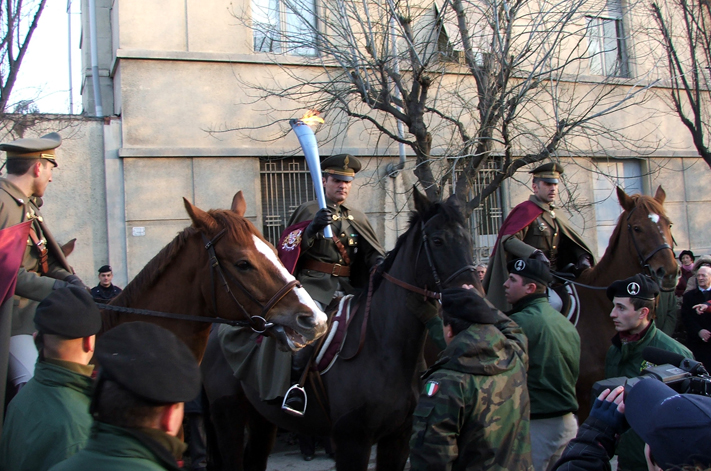
In 1956, for the Winter Games in Cortina D’Ampezzo,the journey of the Flame was again relatively short. This time it was kindled at the Capitol in Rome, in an altar sent from Olympia in Greece.
The Fedeli di Vitorchiano ceremonial guard escorted a footman who carried the Flame to a balcony overlooking the Piazza del Campidoglio. It was greeted with a fanfare of trumpets and a symbolic release of doves. Clemente Cardinal Micara, Vicar General of Rome, offered a blessing before Mayor Salvatore Rebecchini lit the first Torch. Adolfo Consolini, the 1948 Olympic discus champion in 1948, wore a tracksuit to carry it across the piazza as flags of the competing nations were unfurled.
’’Wild applause broke out as Consolini descended,’’ reports said. He passed young gymnasts and members of the Alpine patrol, skis at the ready. Waiting to greet him was Giuseppe ‘Pino’ Dordoni, 1952 gold medallist in the 50 kilometre walk.
‘’Of all the honours I had received in sport, this was the greatest,” Dordoni said. He held the Torch aloft as a car carried him towards the airport, escorted by 100 sportsmen on motorcycles and scooters in bright winter sunshine.
When the Flame reached Venice, a procession of gondolas carried the Flame along the Grand Canal.
As it approached Cortina, 1952 men’s downhill champion Zeno Colo took it down the slopes.
The late Guido Caroli, a speedskater, was the final Torchbearer. Unfortunately, he tripped over a cable connected to a television camera. He did not permit the flame to go out and soon regained his feet to ignite the cauldron.
In 1960, Squaw Valley hosted the Games. They appointed the film producer, Walt Disney, to oversee pageantry and ceremonies including the Torch Relay.
In November 1959 “a spectacular round the world journey” was announced.
“The Torch will be brought from Olympia, Greece, by jet airliner, then run to the Los Angeles Coliseum, site of the 1932 Olympic Games, before making its journey, by foot, through key California cities, including San Francisco and Sacramento.”
Ultimately, it was not lit in Greece, but came instead from Morgedal once again.
Olympic Chancellor Otto Mayer in Lausanne discovered that the organisers had contacted the Hellenic Olympic Committee too late for the necessary arrangements to be made.
In a Lausanne newspaper, Swiss journalist Frederic Schlatter sarcastically observed, “In this case, it is infinitely easier to order the sun to rise in Walt Disney’s films than to make the sun shine in Olympia during the Winter!”
The Flame was therefore lit in Norway, but Torches still bore the inscription “Olympia to Squaw Valley.” There had been no time to change them.
This time 80-year-old ski veteran Eivind Donstad kindled the Flame in the fire at Norheim’s cottage.
The journey to Oslo was made predominantly by car, and in the evening it set out from Fornebu Airport for California.
In Los Angeles, double Olympic shot put champion Parry O’Brien met the Flame and handed a Torch to young athlete Bruce Best, the first of 600 school athletes to carry it to Squaw Valley, where it burned near a Tower of the Nations.
The torches used remain amongst the most collectable. A few years ago, one was auctioned for $215,000.
In 1964, a Flame authentically lit in Olympia was lit a week before the Games in Innsbruck but flown to Vienna. The Flame was eventually lit by skier Josl Rieder and he kept the Torch after the Ceremony. An extensive investigation by Austrian historian Gerhard Siegl suggested that fewer than ten torches may have been made for Innsbruck, although replicas were later made and documentation is inconclusive.
The Torches of Beijing 2022 may well acquire a similar scarcity value.
There are no comments published yet.