
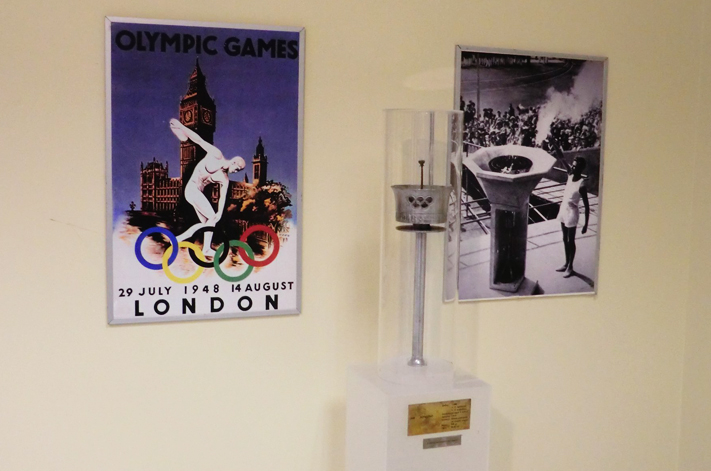
 1948 Torch on display in Olympia
By Philip Barker
Ten years ago, the Olympic Flame was kindled for London 2012 on a glorious day at the site of the Games of antiquity at Ancient Olympia.
It was the second time that London had received an Olympic Flame. Though as organisers prepared for the 1948 Games in an atmosphere of post war austerity, there had been some reservations.
The idea of a Relay had been introduced for the 1936 Games in Berlin and when the idea was made public, one British newspaper branded the enterprise “an antiquarian sham.” It went on to criticise the very idea of holding the Olympics in a time of post war austerity.
“The British public concludes that quite apart from the bad experiences of the past, an event based on such antiquarian sham and portentous symbolism is out of keeping with the spirit of the problems of the modern world.”
The arrangements for the Relay had been put in the hands of retired Royal Navy officer Bill Collins who suggested “those pressmen can be the very deuce when the wrong chap reads what they say.”
He was faced with a number of administrative headaches, many caused by civil servants and Admiralty officials.
The Olympic Torch had been designed by Ralph Lavers. It stood 18 inches high, was made of aluminium, and carried the inscription “London XIV Olympiad, with thanks to the bearer.”
Bureaucrats at the Home Office classified the torches as “Manufactured Fireworks,” and it needed further correspondence to persuade them to “withdraw its onerous classification.”
The red tape was also seen at the Admiralty who were initially unwilling for ships of the Royal Navy to transport what was described as “sentimental symbols” of the Games.
It said much for the diplomatic skill shown by Collins that he was able to persuade the Admiralty to do his bidding.
Collins arrived in Athens to make a first-hand assessment of the civil unrest in Greece.
“I will keep in the closest touch so that any last-minute alterations may be transmitted,” Collins told his colleagues in London.
The fighting made it impossible for the designated High Priestess to travel from Athens. Instead, a local girl, Maria Aggelakopoulou, was persuaded to take on the role, and local villagers set about sewing a costume for her to wear.
The first Torchbearer was a Greek soldier, Corporal Dimitrellis. As a symbolic gesture for peace, before taking the Flame he took off his army uniform.
The possibility of attack meant that organisers decided to shorten the route in Greece.
Collins sent a cable to London to warn officials back home of the alteration to arrangements: “FLAME WILL NOW BE CARRIED BY RUNNERS OLYMPIA TO PYRGOS AND KATAKALON AND THENCE BY DESTROYER”
It was taken to Corfu where it was placed on board the HMS Whitesand Bay which conveyed the Flame to the Italian port of Bari.
It eventually reached Dover less than 24 hours before the Games were due to open and was carried through the night to reach Wembley in time for the Ceremony.
The tribulations faced by Collins present a contrast with the arrangements made for 2012.
It had been decided that the Relay should visit all parts of the British Isles in an expansive domestic Relay which lasted over two months.
The London Torch was designed by Edward Barber and Jay Osgerby and rendered in aluminium alloy with a weight of 800 grams.
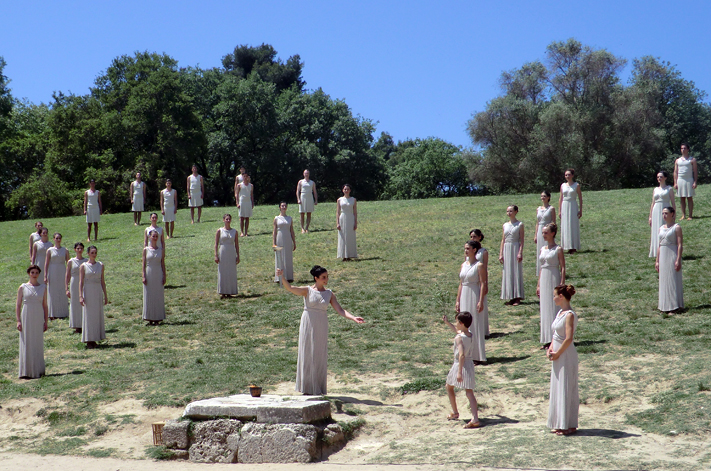
The Lighting Ceremony was held on 10th May 2012 in Olympia.
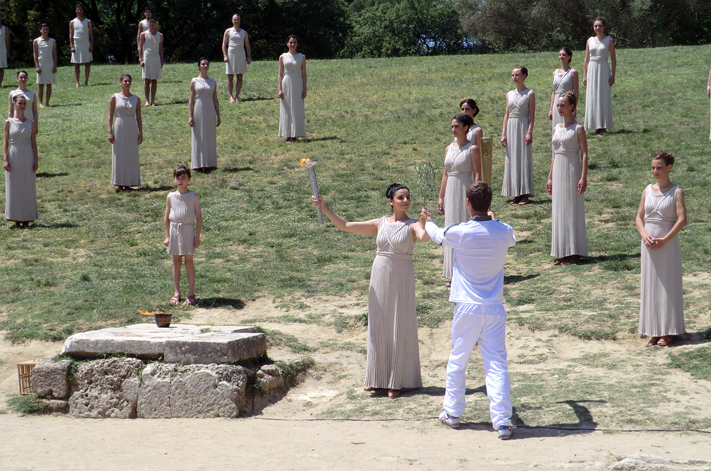
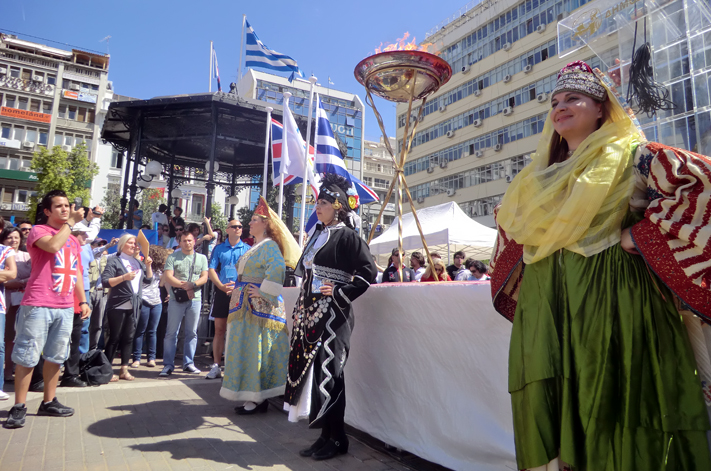
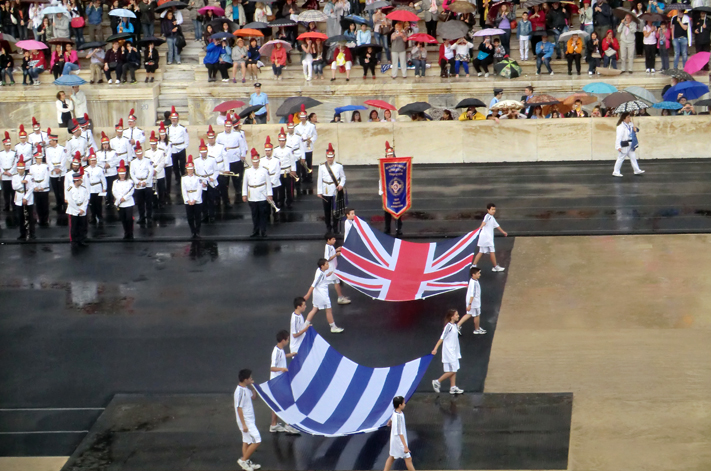
The streets were festooned with Greek and British flags as London Organising Committee (LOCOG) Chairman Lord Coe, IOC Vice President Sir Craig Reedie and British Olympic Association (BOA) Chairman Lord Moynihan watched the Ceremony as Ino Menegaki, a Greek actress who played the role of High Priestess, lit an Olympic Flame from the rays of the sun.
It was Spiros Gianniotis, a Greek open water swimmer, who carried the first London Torch from the Ancient Stadium and shortly afterwards, he passed the Flame to Alex Loukos, one of London 2012’s young ambassadors when they had been awarded the Games in Singapore seven years before.
The cavalcade set off through the village of Olympia and headed out across Greece on an itinerary which included the island of Crete.
The Flame was taken to the Turkish border outpost of Kipi where a cauldron was lit by Olympic Torch Relay Commission Chairman Spyros Zannias.
“We brought the Flame here to the border between Greece and Turkey to prove that there is nothing that separates the people of the planet,” Zinnias declared.
Everywhere it went in Greece, it was greeted by dance and music from performers in traditional costumes.
Finally, it reached the capital and was taken up the Acropolis Hill on a sunny Athenian evening by Artemis Ignatiou the chief choreographer of the lighting ceremony who had swapped roles for a few memorable moments.
A traditional tripod cauldron was lit in front of the Parthenon in a ceremony, watched by the Princess Royal in her capacity as BOA President.
Coe had pledged to his Greek hosts, “We promise to protect the Flame, to cherish its traditions and to stage an uplifting Torch Relay of which we can all be proud and which can inspire a generation.”
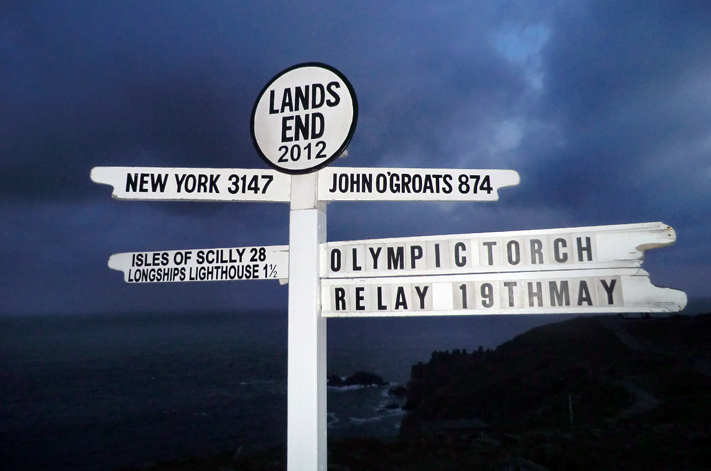
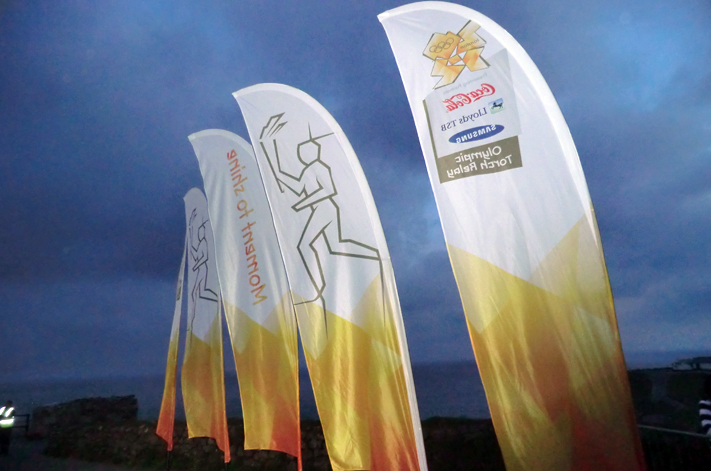
There was to be foretaste of the pulling power that the Flame was about to exert when hundreds turned out even before the sun had risen at the southernmost spot on the British mainland, appropriately known as Land’s End.
Sir Ben Ainslie, at the time a four-time Olympic gold medallist, became the first of 8000 runners to carry it the length and breadth of the nation in a Relay which set the mood for the upcoming Games.
The excitement produced by that Relay was long remembered and seems even more precious after the disruption of so many sporting events and ceremonies because of COVID restrictions.
These were keenly felt by the organisers of the Relays for both Tokyo and Beijing.
There are no comments published yet.