
 GDR NOC President, Heinz Schobel (left) and FRG NOC President, Dr. Ritter von Halt, circa 1956.
Germany’s “Fussball Problem”
by Philip Barker
A single goal in Hamburg at the FIFA World Cup 50 years ago gave East Germany victory over West Germany in what may have been the most politically charged international football match ever staged.
It was the only time that East Germany, officially known as the German Democratic Republic (GDR) met their Western counterparts in a full international, yet there had been Olympic encounters conducted against the same Cold War backdrop.
After the second World War, Germany was excluded from international sport and the Olympic Movement, but in 1950, Berlin High Commissioner General Brian Robertson wrote to International Olympic Committee (IOC) member Lord Burghley.
“After all the terrible things that have happened in Germany during the recent past, it seems clear to me that we must look to the youth to make a new start.”
The IOC welcomed the idea, but the East German politburo dragged their heels.
In 1952, only competitors from West Germany took part in Helsinki, but even so, in football, they reached the semi final.
It was not until 1955 that an East German National Olympic Committee was granted recognition at the IOC Session in Paris..
This came with the condition that “should it prove impossible to form a unified team from both Germanies, this recognition will lapse automatically.”
This was because IOC President Avery Brundage was committed to the idea of a single German team at the Games.
“It was his attachment to German culture in general and to his German friends in particular which impelled him stubbornly to seek a single Germany in the world of sport when there were manifestly two Germanies in the world of politics.” observed Allen Guttman in his biography.
In 1956, the Germanies marched together at the Cortina Winter Games and in Melbourne, but unity was largely superficial.
It had been intended that a football team should include both sides but only players from the West made the 16,000 kilometre journey to Australia. They lost to the Soviet Union in their only match.
Discussions continued to be difficult, but on September 4th and 5th 1959, officials met at Wartburg Eisenach and thrashed out a compromise to the “Fussball Problem.”
A two-leg eliminator was to decide who would represent “Germany” in Olympic qualifiers.
They were dubbed “Geisterspiel’ (ghost matches) because only around 60 people were present including players, officials, journalists and police.
World Cup winning coach Sepp Herberger, a legendary figure took charge of the West’s amateur side for the matches.
The first leg was played at the Walter Ulbricht Stadium in East Berlin.
A first goal by Dieter Fischer and a second from “Charly” Dörfel seven minutes from the end gave the West a healthy advantage.
A week later, a 2-1 victory at the Rheinstadion in Dusseldorf completed an aggregate victory but there was to be no German team at the Rome Olympics because they lost to Poland and Finland in the next phase of qualification.
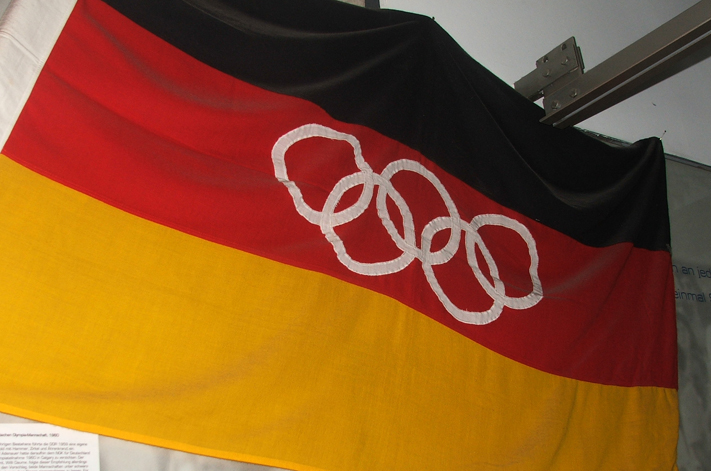
A specially designed flag had been introduced for the “United” German team, but tensions intensified after the East German government began construction of the Berlin Wall in 1961.
The West initially refused to accept sporting competition against the East, yet the fragile Olympic agreement remained in place and with it two elimination matches in football.
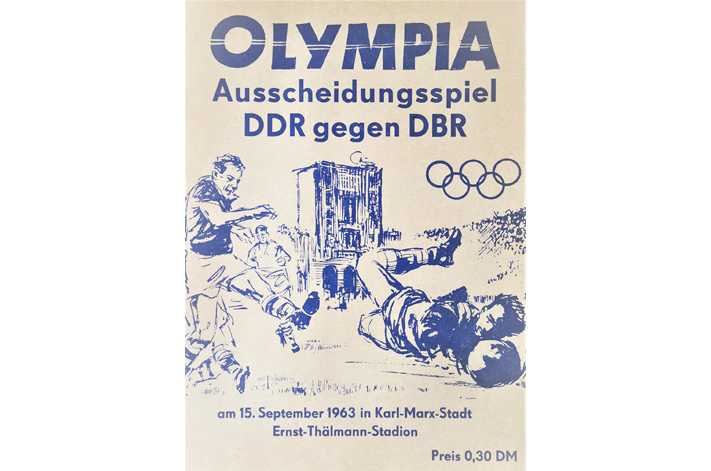
“Unfortunately there were some difficulties in the preparation, it is common knowledge that the IOC had to intervene again before these encounters could take place,” admitted East German Football Federation (DFV) President Helmut Riedel in his programme notes for the first leg played in September 1963 at the Ernst Thalmann Stadium in Karl Marx Stadt (now Chemnitz).
“In any case, we are honestly happy that the point of view of sporting reason has finally prevailed. You all know that we have a special football sporting event coming up today.”
The first leg attracted 50.000.
Goalkeeper Sepp Maier a World Cup winner in 1974 was named in the German squad but did not get a game.
Heino Kleiminger opened the scoring for the GDR after 25 minutes, Hermann Stocker added a second six minutes later, and Jurgen Noldner made it three ten minutes after the break.
The West won the return 2-1 in Hanover but the GDR went through on aggregate.
They defeated the Netherlands and the Soviet Union in further qualification, and at the Games in Tokyo they won bronze.
By now, however, athletics and some other sports had agreed that the GDR compete separately.
At the 1965 IOC Session in Madrid, the GDR NOC announced that “arrangement to field a joint team was no longer acceptable.”
GDR NOC President Heinz Schobel admitted that the situation was “undeniably tense” but asked for a “sportsmanlike solution.”
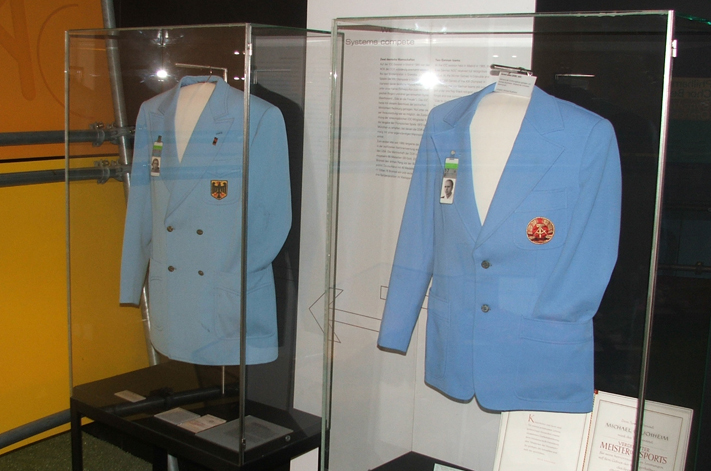
It was resolved that each would compete separately at the Mexico 1968 Games.
Neither nation qualified for the football tournament. West Germany lost to Great Britain and Bulgaria defeated the GDR in the qualification matches.
For the 1972 Munich Games, the GDR beat Yugoslavia to qualify for the football tournament.
Both sides came through the first pool phase at the Games. The second round was another mini league in which East and West met again in the Olympic stadium.
Both had lost to Hungary, but the GDR had beaten Mexico 7-0. West Germany could only draw 1-1 with the same opponents.
The GDR needed only a point from the match in Munich’s Olympiastadion to reach the bronze medal playoff.
Jürgen Pommerenke gave them a first half lead, but a superb lob from Uli Hoeness of Bayern Munich, playing on his home ground, equalised before half time.
In the second half, a close range header from Joachim Streich restored the East’s advantage. Another header from Otmar Hitzfeld made it 2-2 . The deciding goal came eight minutes from time. Ebehard Vogel was unmarked as the winner for the GDR.
They went on to win bronze but never again faced West Germany in Olympic football competition.
These Olympic meetings have been largely overshadowed by the 1974 World Cup meeting.
“There was quite an uproar in the packed hall when it became evident that the teams from the two German states would be drawn together,” said the official FIFA report.
West Germany beat Chile in their opening match and then defeated Australia 3-0.
East Germany also beat the Australians but only drew with Chile.
“East Germany’s players are amateurs they are not stimulated in any way materially, they are stimulated by the motivation of the cause,” insisted manager Georg Buschner.
“We did not come here expecting to win the World Championship but rather to learn to become better players.”
By the time both sides walked out for their historic encounter in Hamburg, both were sure of qualification. This was because Chile had only drawn with Australia earlier in the day.
“They (GDR) played as if their nerves were totally unaffected by this inter-German battle for prestige,” was the verdict of the official FIFA Report.
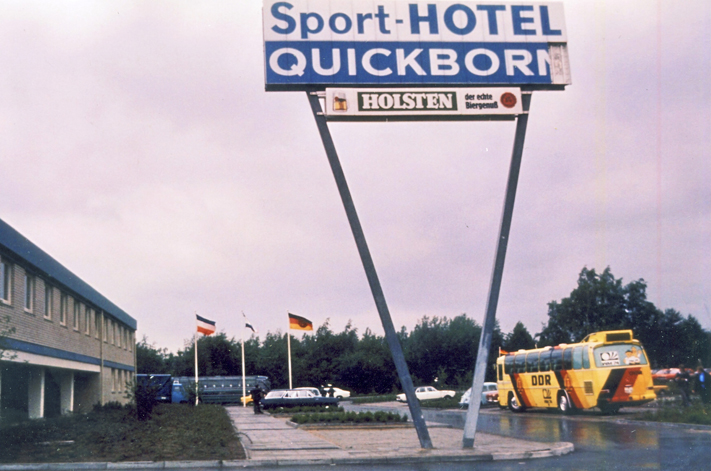
With 12 minutes remaining, Jurgen Sparwasser burst through to score the goal which decided the match for the GDR to the delight of 1,700 fans, permitted to cross the border to watch the match.
The result put West Germany into what was arguably the weaker second round group and they went onto reach the Final.
They recovered from a first minute penalty against the Netherlands to win 2-1. Captain Franz Beckenbauer was the first man to lift the new FIFA World Cup trophy.
With seven players from 1974 in their squad, the GDR went on to win Olympic football gold in 1976, but they never played West Germany again.
They were drawn together in the qualifying group for the 1992 European Championship but before the matches could be played, the Berlin wall came down and very soon the GDR itself was no more.
There are no comments published yet.