
 History repeated itself in the 1972 Olympic Football tournament


by Philip Barker at the Olympic Stadium in Munich
As the 1972 Olympic Games came to a close, a “golden generation” of Polish footballers announced themselves by winning Olympic gold on a rainswept night in Munich.
Poland returned to West Germany to play in the 1974 FIFA World Cup finals and produced electrifying football which almost swept them to the final.
In the end, they were knocked out by the host nation West Germany.
By a curious twist of fate, the West Germans also shattered the World Cup ambitions of Hungary’s ‘Golden Team’ in 1954.
The Hungarians had begun a long unbeaten run in 1950 and were inspired by Ferenc Puskas, still revered as one of the greatest players in world football.
“Throughout the winter of 1951 we were already preparing intensively for the Olympic Games in Helsinki,” Puskas recalled in his memoir Captain of Hungary.
“From early spring we worked and worked and worked.”
The team stayed at Otaniemi on the Finnish coast to prepare for the Helsinki Olympics.
“Everything for our well-being and fitness was assured, all that remained was for us to play well,” Puskas wrote.
Hungary beat Romania 2-1 even before the Olympic Flame had been lit.
Then at the Opening Ceremony, Puskas recalled the arrival of Paavo Nurmi, the legendary Finnish athlete who carried the Olympic Torch.
“I had heard so much about him as a child and I admired now his youthful movements as in spite of his age he ran nimbly around the stadium with the Torch and lit the flame of the Olympic Games.”
In their second match, Hungary defeated Italy 3-0, followed by a 7-1 quarter-final victory over Turkey.
In the semi-final, they defeated Sweden 6-0.
“Our play against Sweden was such that for a long time, the world’s newspapers held it up as an example of what football should be,” Puskas reported proudly.
He had a penalty saved in the first half of the final against Yugoslavia but scored with 20 minutes left and Zoltan Czibor clinched gold with a second.
Future FIFA President Sir Stanley Rous was so impressed that he immediately issued an invitation for the Hungarians to play at Wembley.
They did so in November 1953, took the lead through Nándor Hidegkuti after only 90 seconds, and eventually won 6-3.
“One can tip the Hungarians as world champions,” was the forecast of Swedish newspaper Dagens Nyheter, even before Hungary had beaten England 7-1 in the return match played in Budapest the following year.
“Hungary had forgotten nothing and England hadn’t learnt a thing,” was the verdict of Willy Meisl, an Austrian journalist who now worked for the British magazine World Sports.
When the tournament began for real, Hungary’s Sandor Koscis scored a hat-trick in a record 9-0 victory over South Korea.
They then faced West Germany, coached by Sepp Herberger, almost inevitably described as ‘wily.’
It was a match Herberger calculated that he could afford to lose.
The Hungarians scored three times in the first 21 minutes and eventually won 8-3 but victory came at a price when Puskas was injured.
“I received a vicious kick on the back of the ankle,” he recalled.
In the quarter final, known as the “Battle of Berne” after three players were sent off, Hungary defeated Brazil 4-2.
A brawl followed the final whistle.
In the semi-final, Hungary beat Uruguay 4-2 after extra time.
Puskas did return for the final against West Germany but although the Hungarians were soon two up, the Germans fought back and eventually won 3-2 after a match played in torrential rain.
Hungary had a goal disallowed in the final minutes.
Their team broke up in 1956 in the aftermath of the Hungarian uprising and never quite reached the same heights although they won Olympic gold again in 1964 and 1968.
Their pathway to a hat-trick in 1972 was challenged by another outstanding team from Eastern Europe.
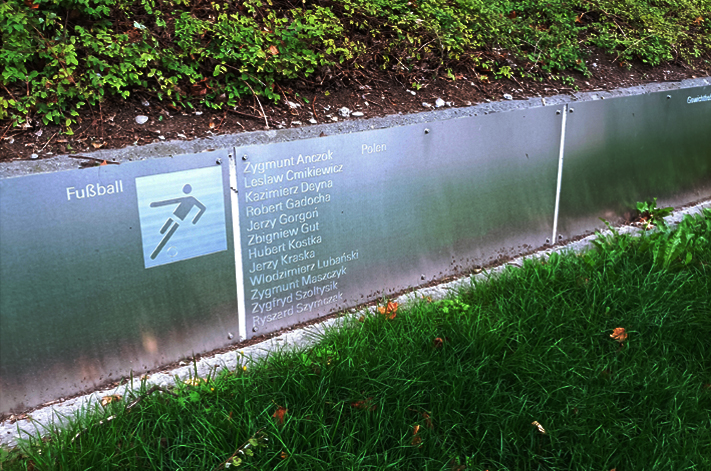
Poland included Grzegorz Lato, Kazimierz Deyna and Jerzy Gorgon, all destined to play at the World Cup finals.
FIFA’s official report described them as “a side which had made great strides in the process of development over the last few years,”
They beat Colombia, Ghana and East Germany in the opening pool.
In the second round, also in a round robin format, they drew 1-1 with Denmark, beat the Soviets 2-1 and Morocco 5-0.
In the final, played on a wet evening, opponents Hungary scored first through Bela Varadi. Two goals from Deyna gave Poland the gold.
Deyna had scored nine goals in the course of the tournament.
“I’ve been waiting for such a moment for twenty years,” Polish television commentator Jan Ciszewski exclaimed.
Poland also played England twice in the year which followed, because they were drawn in the same FIFA World Cup qualifying group.
They won 2-0 in Chorzow and needed only a draw against England at Wembley in October 1973 to qualify for the finals.
Before the match the Polish goalkeeper Jan Tomaszewski had been described as “a clown” by British football manager and television pundit Brian Clough.
Tomaszewski had not played at the Olympics, but proved almost unbeatable at Wembley.
Poland scored with a breakaway and although England equalised with a penalty, 1-1 was sufficient for the Poles to qualify for the World Cup finals in West Germany.
The following June, Poland beat Argentina 3-2 in Stuttgart in their opening World Cup group match.
“The Poles demonstrated excellent soccer, a high tempo, practised moves and they were willing to have a crack at goal,” said the FIFA Report.
An excellent 2-1 victory over Italy took them through to the second phase as group winners.
Poland beat Sweden 1-0 and defeated Yugoslavia 2-1.
In the final match they faced host nation West Germany with a place in the final at stake.
Tournament organisers had used a computer to choose the driest time for the tournament, but a heavy downpour in Frankfurt flooded the field an hour before the start.
“There was reasonable hope that the fire brigade and stadium ground staff would manage to make the pitch playable,” the FIFA Report said.
“They succeeded on one side of the field, the other still resembled a group of lakes.”
One goal decided the match and it was scored by West Germany’s deadly striker Gerd Muller.
Poland eventually finished third, and with seven goals, Lato was top scorer in the tournament.
Even so, World Cup glory eluded Olympic champions Poland just as it had Hungary 20 years before.
Each time the Germans were responsible.
There are no comments published yet.